

The Herpetological Journal
The Herpetological Journal is the Society's prestigious quarterly scientific journal. Articles are listed in Biological Abstracts, Current Awareness in Biological Sciences,Current Contents, Science Citation Index, and Zoological Record.
ISSN 0268-0130
2023 Impact Factor for the Herpetological Journal is 1.1, with the Journal sitting just below Quartile 2 in Zoology, at percentile 46.9
08. The role of anthropogenic habitat modifications in the structuring of functional groups of anuran communities in the Sierra Madre del Sur, Mexico
17 downloads
Subscription / purchase required
DOI: https://doi.org/10.33256/36.1.7286
pp. 72-86
Authors: Gerardo J. Soria-Ortiz, Leticia M. Ochoa-Ochoa, Julieta A. Rosell & Ella Vázquez-Domínguez
Abstract: Amphibians are particularly vulnerable to anthropogenic habitat modifications. Nonetheless, some species are tolerant and persist in modified sites due to unique functional traits. We evaluated how environmental variables (structural, climatic and water physicochemical) derived from anthropogenic modifications structure communities of amphibians from a functional perspective in the Sierra Madre del Sur, Mexico. We sampled 34 sites with varying degrees of habitat modification and classified the anuran community in five functional groups. Redundancy analysis and zero-inflated negative binomial generalised linear mixed models were used to evaluate the relationship between abundance (number of individuals per functional group) and the environmental variables. Results support that community structure and abundance are determined by the ecological preferences and diversity of functional traits of the species. Positive relationships prevailed between abundance and variables of water quality for anurans with rapid development, and humidity for anurans with direct development. Aggregation of forest patches and bare soil areas favoured groups with medium to large arboreal and terrestrial anurans, while these were negatively impacted by agriculture areas. Functional groups with higher abundance where water bodies exhibited certain physicochemical toxic levels were associated with the arrangement and composition of patches of different land uses. We highlight the importance of considering functional groups and landscape variables for understanding the community structure and habitat use of anurans. Specifically, for the anthropogenic landscapes studied, considering key environmental variables that allow sustaining the species’ functional traits is essential, with emphasis on an adequate management of water bodies, to establish effective conservation measures.
Keywords: amphibians, environmental filters, functional traits, landscape metrics, water pollution
Download Access:
The latest 8 issues can be downloaded when logged in with a Herpetological Journal subscription membership.
Individual articles can be purchased for download.
Older issues and occasional Open Access articles are available for public download
Submissions:
For further information and submission guidelines please see our Journal Instructions to Authors

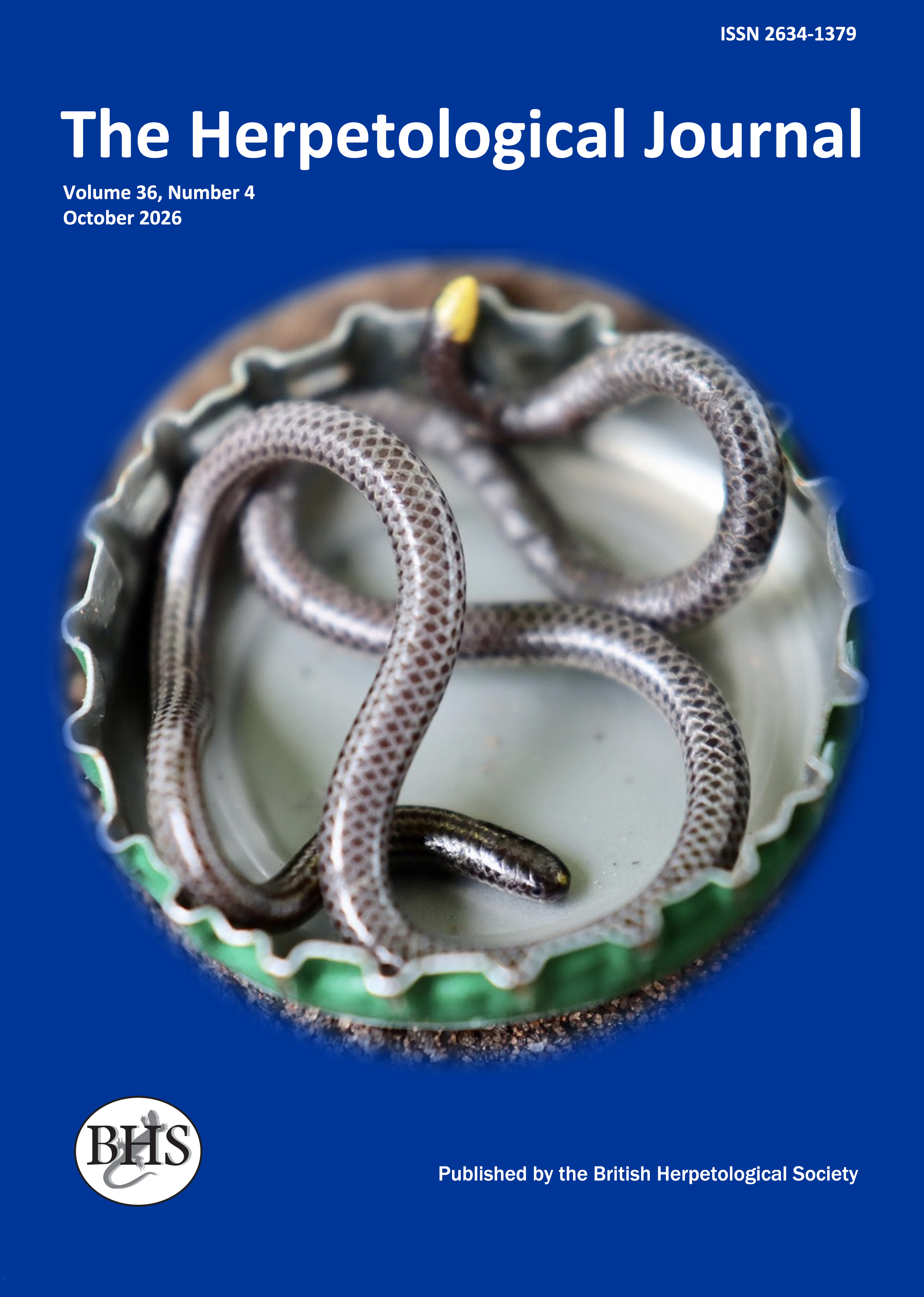
Latest Issue
IMPORTANT NOTE - JUNE 2020
Please note that as from Volume 31 Number 1 (January 2021) on, the Herpetological Journal will be available as an online publication only - the last print edition will be Volume 30 Number 4.
Aligning with this change, it is now no longer possible to purchase a subscription that includes a print copy of the HJ. All members who have existing HJ print subscriptions that remain active as at end June 2020 will receive the full four 2020 print editions. New subscribers or renewals after this time will only have option to subscribe to the online only subscription package. Subscription pricing has been amended to reflect the content changes.