

The Herpetological Journal
The Herpetological Journal is the Society's prestigious quarterly scientific journal. Articles are listed in Biological Abstracts, Current Awareness in Biological Sciences,Current Contents, Science Citation Index, and Zoological Record.
ISSN 0268-0130
2023 Impact Factor for the Herpetological Journal is 1.1, with the Journal sitting just below Quartile 2 in Zoology, at percentile 46.9
pdf Reproduction of Brazilian amphisbaenian Amphisbaena brasiliana (Gray, 1865) (Squamata, Amphisbaenidae)
3 downloads
Subscription / purchase required
Authors: Roberta Ferreira Abecassis, Alfredo P. Santos-Jr, Lucas Vinicius Cavalcante Esteves, Advanio Inácio Siqueira-Silva, Selma Maria Almeida-Santos & Síria Ribeiro
Abstract: We studied the sexual dimorphism and reproductive cycle of Amphisbaena brasiliana, based on specimens from the municipality of Santarém, Pará state, Brazil, and tested whether precipitation affects the cycle. We accessed and analysed 143 individuals (73 males, 70 females), deposited in scientific collections between 1999 and 2021. We analysed: snout-vent length (SVL), testicular length, width and height, condition of the ductus deferens (convoluted or non-convoluted), diameter of the ductus deferens in the medial and distal portion, condition of the oviducts (convoluted or non-convoluted), length of the largest follicle and number of primary and secondary follicles (vitellogenic follicles). The SVL of females ranged from 149.10–363.11 mm, with 46 specimens (66%) being mature (smallest adult female = 246.46 mm). Male SVL ranged from 123.31–337.26 mm, with 42 (58%) being mature (smallest adult male = 242.0 mm). The sample does not present significant variation in sexual dimorphism analysed in SVL (Mann-Whitney: P = 0.932). Testicle volume and ductus deferens diameter varied seasonally, with the highest values recorded from August to December, during the low rainfall period. Spermatozoa were recorded in the ductus deferens during the low rainfall months in the region, especially in September, when we observed more individuals with ductus deferens convoluted, which may indicate spermatozoa storage. The testicular volume and the diameter of the ductus deferens in the medial and distal portions are related to the period of lower precipitation (ANOVA: P = 2.1 x 10⁻⁵; P = 5.18 x 10⁻⁶; P = 1.56 x 10⁻⁵, respectively). We recorded oviductal eggs in one specimen in December, in addition to the record of vitellogenic follicles in September, October and December, which allows us to interpret a peak of development in the period of lower precipitation, coinciding with the results for males of the species. Our results suggest that the reproductive cycle of the population of A. brasiliana analysed may be influenced by regional rainfall, being seasonal.
Keywords: Amazon, Amphisbaenia, natural history, reproductive cycle, spermatogenesis
Download Access:
The latest 8 issues can be downloaded when logged in with a Herpetological Journal subscription membership.
Individual articles can be purchased for download.
Older issues and occasional Open Access articles are available for public download
Submissions:
For further information and submission guidelines please see our Journal Instructions to Authors

Latest Issue
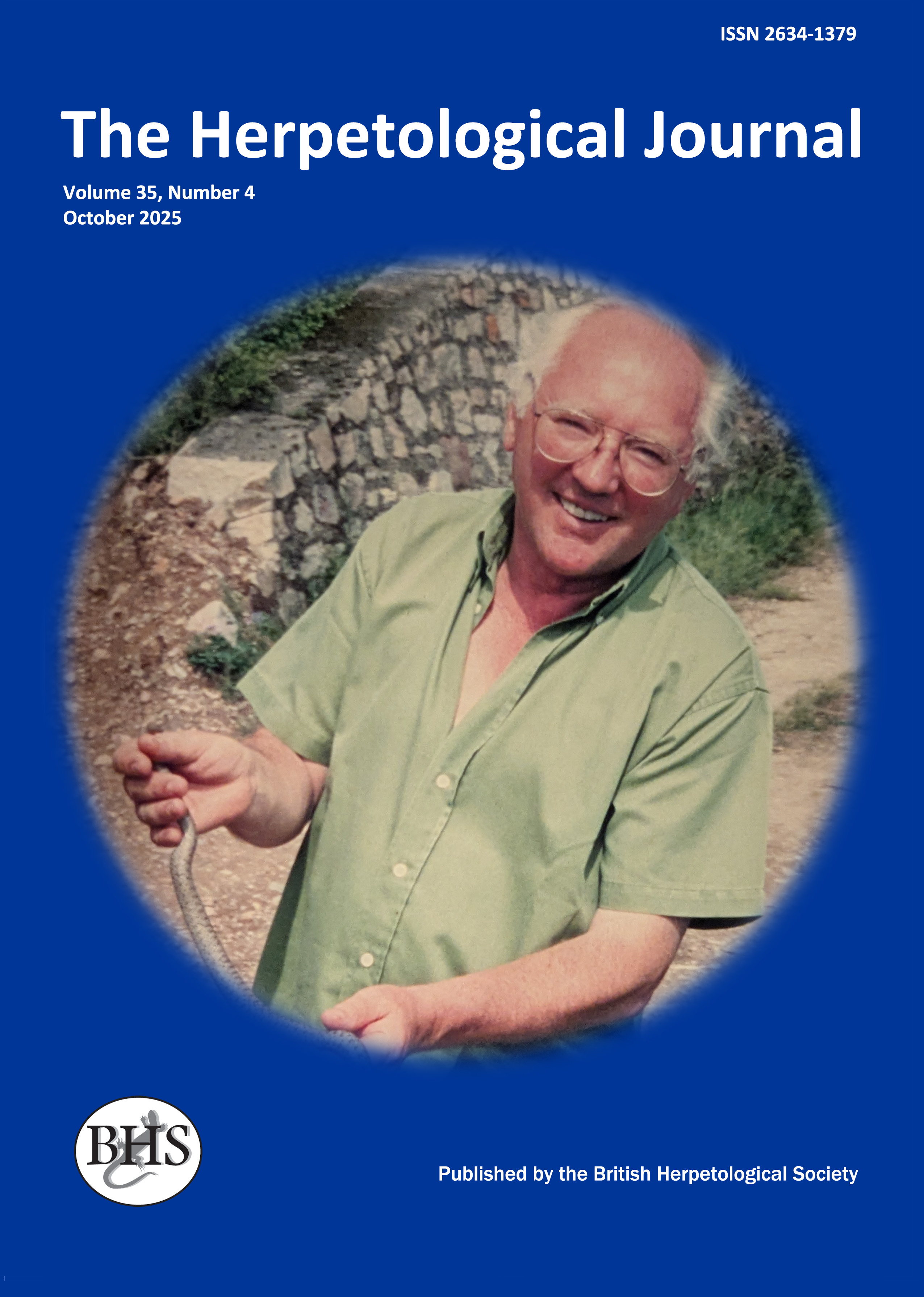
IMPORTANT NOTE - JUNE 2020
Please note that as from Volume 31 Number 1 (January 2021) on, the Herpetological Journal will be available as an online publication only - the last print edition will be Volume 30 Number 4.
Aligning with this change, it is now no longer possible to purchase a subscription that includes a print copy of the HJ. All members who have existing HJ print subscriptions that remain active as at end June 2020 will receive the full four 2020 print editions. New subscribers or renewals after this time will only have option to subscribe to the online only subscription package. Subscription pricing has been amended to reflect the content changes.