

The Herpetological Journal
The Herpetological Journal is the Society's prestigious quarterly scientific journal. Articles are listed in Biological Abstracts, Current Awareness in Biological Sciences,Current Contents, Science Citation Index, and Zoological Record.
ISSN 0268-0130
2023 Impact Factor for the Herpetological Journal is 1.1, with the Journal sitting just below Quartile 2 in Zoology, at percentile 46.9
pdf Unexpected biogeographical patterns? The case of the apparently widespread Trachycephalus typhonius (Anura: Hylidae)
1 download
Subscription / purchase required
Authors: Angela M. Mendoza-Henao, Juan Alejandro Guerrero-Cupacan, Khristian Venegas-Valencia & Mailyn A. Gonzalez
Abstract: Taxonomic and spatial biases limit the understanding of biodiversity patterns, particularly in the Neotropics, with consequences in systematics, biogeography and conservation. Here, we address the impact of these biases by focusing on the widespread species Trachycephalus typhonius. Despite its common occurrence across its range, misidentifications and cryptic diversity have obscured its true phylogenetic and biogeographic histories. Through extensive field sampling and molecular analysis of cis- and trans-Andean localities, we revealed substantial genetic divergence within T. typhonius, which suggests the presence of multiple cryptic species. The samples from Orinoquia (cis-Andes) and Magdalena Valley (trans-Andes) in Colombia, differ from T. typhonius sensu stricto in Guyana. At least three lineages were observed for T. typhonius across the continent, suggesting a complex diversification pattern shaped by major Neotropical barriers. Our results show the influence of both Andes and Amazon-Orinoquia on the phylogeographic structure and provide insights into the biogeographic history of T. typhonius sensu lato. We discuss the importance of addressing taxonomic and spatial biases, and highlight how geographic barriers and historical processes have influenced diversification in the Neotropics. Our findings illustrate the need for comprehensive sampling and molecular studies for ‘common’ species, to unravel hidden diversity, which is crucial for accurate biodiversity assessments, understanding evolutionary processes, refine biogeographic models, reassess species distributions and inform conservation strategies. Este resumen traducido al español está disponible en supplementary materials.
Keywords: cryptic diversity, Amazon, phylogeography, sampling biases, Neotropics
Download Access:
The latest 8 issues can be downloaded when logged in with a Herpetological Journal subscription membership.
Individual articles can be purchased for download.
Older issues and occasional Open Access articles are available for public download
Submissions:
For further information and submission guidelines please see our Journal Instructions to Authors

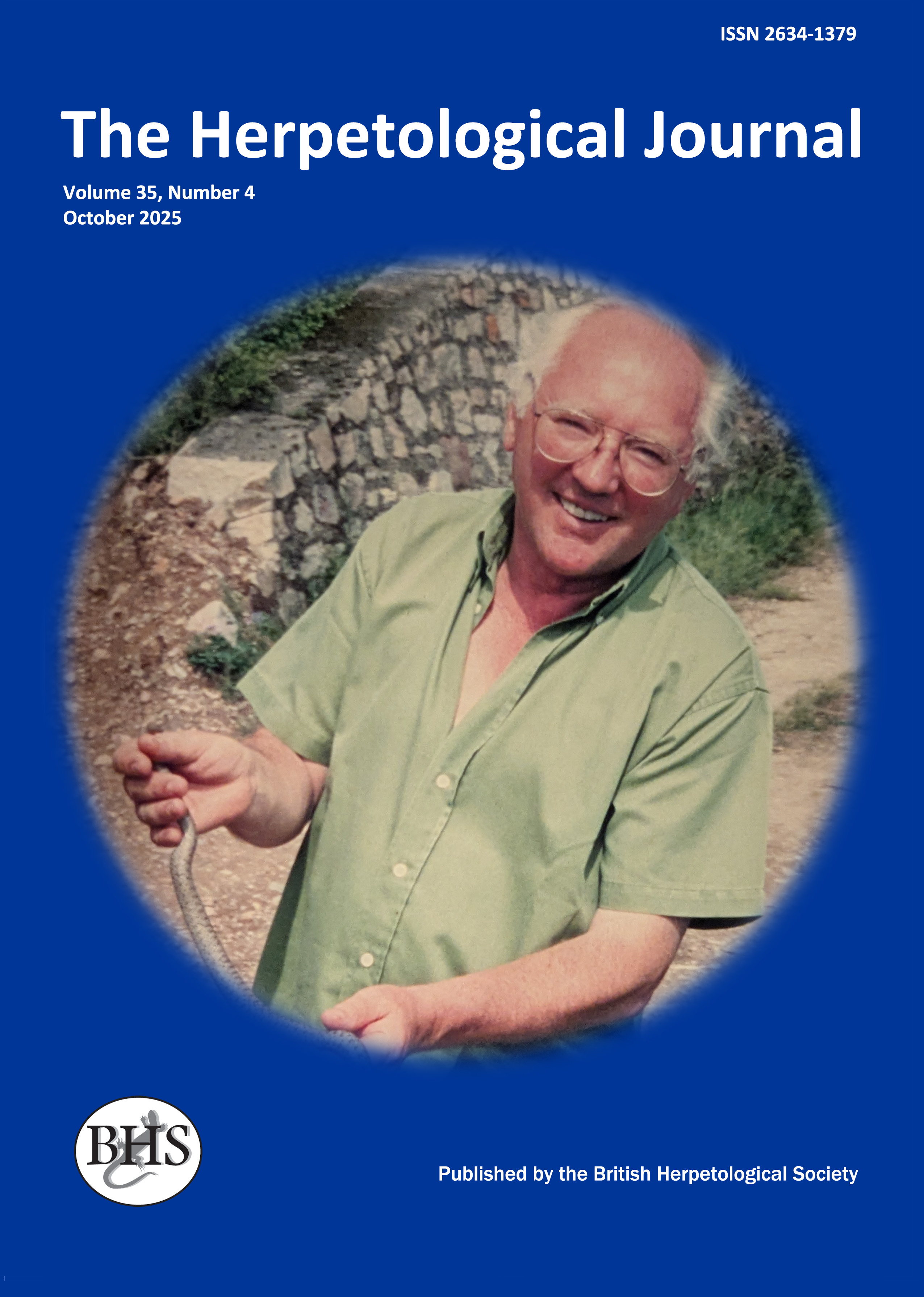
Latest Issue
IMPORTANT NOTE - JUNE 2020
Please note that as from Volume 31 Number 1 (January 2021) on, the Herpetological Journal will be available as an online publication only - the last print edition will be Volume 30 Number 4.
Aligning with this change, it is now no longer possible to purchase a subscription that includes a print copy of the HJ. All members who have existing HJ print subscriptions that remain active as at end June 2020 will receive the full four 2020 print editions. New subscribers or renewals after this time will only have option to subscribe to the online only subscription package. Subscription pricing has been amended to reflect the content changes.