

The Herpetological Journal
The Herpetological Journal is the Society's prestigious quarterly scientific journal. Articles are listed in Biological Abstracts, Current Awareness in Biological Sciences,Current Contents, Science Citation Index, and Zoological Record.
ISSN 0268-0130
2023 Impact Factor for the Herpetological Journal is 1.1, with the Journal sitting just below Quartile 2 in Zoology, at percentile 46.9
01. Predicting habitat suitability and distribution patterns of Epictia borapeliotes (Leptotyphlopidae: Epictinae) using ecological niche modelling
Subscription / purchase required
Authors: Roberta R. Pinto, Samuel C. Ribeiro, Átilas R. Sousa & Robson W. Ávila
Abstract: Epictia borapeliotes is a fossorial blind snake endemic to north-eastern Brazil. Despite its ecological role as a specialised predator of social insects, its occupancy patterns and the environmental drivers within the Caatinga and Atlantic Forest biomes remain poorly understood due to its cryptic lifestyle. This study reassessed the species' geographic distribution, expanded the knowledge of its morphological variation, and identified areas of environmental suitability through Ecological Niche Modeling (ENM). Based on a dataset of 135 individuals and 42 filtered occurrence points, seven modeling algorithms were correlated with 11 bioclimatic and topographic variables. Results indicate a broad distribution across the Brazilian Northeast, encompassing approximately 100,000 – 140,000 km² across Caatinga, Atlantic Forest and urban zones, suggesting high habitat plasticity. ENM showed high predictive performance (TSS = 0.87; ROC = 0.89) and identified peak habitat suitability in the eastern Borborema Plateau and eastern Rio Grande do Norte. Habitat suitability was primarily driven by annual temperature range (Bio7), isothermality (Bio3), precipitation seasonality (Bio15) and terrain slope, with optimal conditions occurring on moderate slopes (mean ~8°) that provide stable thermal gradients and favourable conditions for prey availability. Models incorporating ENVIREM predictors expanded the estimated suitable area by approximately 43%, highlighting the importance of energy-water balance variables – such as potential evapotranspiration and climatic moisture index – in shaping the species’ ecological niche. Despite occurring across a range of rainfall regimes, Epictia borapeliotes appears to depend on thermally stable environments to maintain its biological functions. These findings provide a spatial framework for targeted surveys and reveal a substantial mismatch between suitable habitat and protected areas, offering key insights for conservation planning of fossorial fauna in seasonal tropical ecosystems.
Keywords: Scolecophidia, epictini, geographic distribution, ecological variation, snakes
Download Access:
The latest 8 issues can be downloaded when logged in with a Herpetological Journal subscription membership.
Individual articles can be purchased for download.
Older issues and occasional Open Access articles are available for public download
Submissions:
For further information and submission guidelines please see our Journal Instructions to Authors

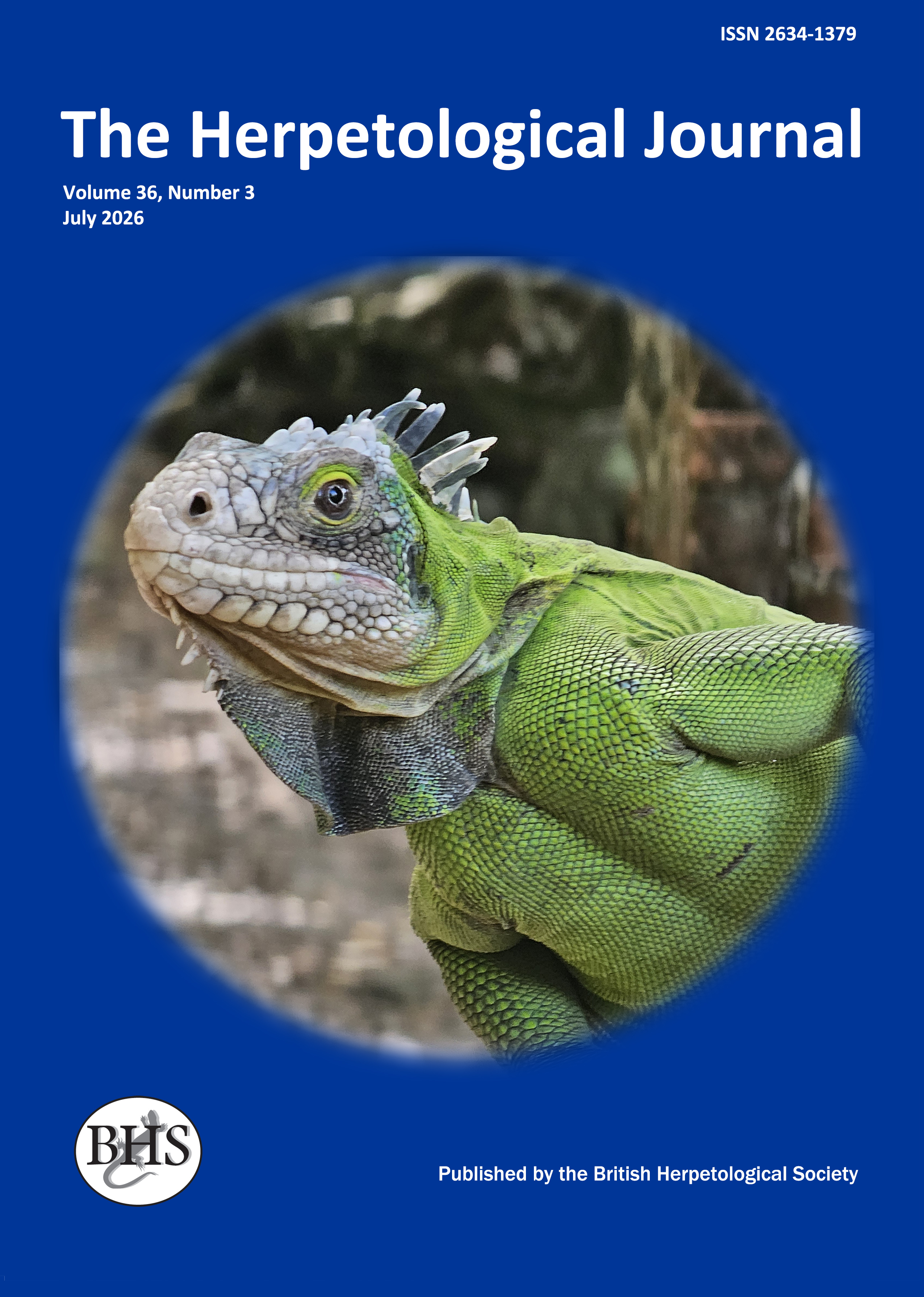
Latest Issue
IMPORTANT NOTE - JUNE 2020
Please note that as from Volume 31 Number 1 (January 2021) on, the Herpetological Journal will be available as an online publication only - the last print edition will be Volume 30 Number 4.
Aligning with this change, it is now no longer possible to purchase a subscription that includes a print copy of the HJ. All members who have existing HJ print subscriptions that remain active as at end June 2020 will receive the full four 2020 print editions. New subscribers or renewals after this time will only have option to subscribe to the online only subscription package. Subscription pricing has been amended to reflect the content changes.