

The Herpetological Journal
The Herpetological Journal is the Society's prestigious quarterly scientific journal. Articles are listed in Biological Abstracts, Current Awareness in Biological Sciences,Current Contents, Science Citation Index, and Zoological Record.
ISSN 0268-0130
2023 Impact Factor for the Herpetological Journal is 1.1, with the Journal sitting just below Quartile 2 in Zoology, at percentile 46.9
02. Population genetic structure of a Colombian endemic poison frog Dendrobates truncatus (Anura: Dendrobatidae): A contribution to its conservation
2 downloads
Subscription / purchase required
DOI: https://doi.org/10.33256/36.4.237248
pp. 237-248
Authors: Mario Vargas-Ramírez, Sabine Nürnberg & Raffael Ernst
Abstract: The yellow-striped poison frog Dendrobates truncatus is endemic to Colombia. Despite its ecological plasticity and apparent abundance, which led to its classification as Least Concern (LC) on the IUCN Red List, it is crucial to objectively assess its conservation status, as the species faces significant threats from habitat modification and destruction, as well as the pet trade. Conservation genetics and phylogeographic approaches can provide valuable insights for such evaluation. To this end, multiple populations across the species' distribution range were genetically analysed using mitochondrial DNA sequences (Cytochrome b) and nuclear DNA markers (microsatellite loci). While mitochondrial data revealed phylogeographic structure with three main genetic groups, nuclear data revealed three or five populations across the species' distribution range. Both markers indicated clear population structure, high genetic diversity and evidence of population expansion. This genetic structure likely results from a combination of ecological, biogeographical and anthropogenic factors. The identified populations represent independent management units, underscoring the need for tailored conservation strategies. These findings provide a foundation for further research and the development of effective management and conservation strategies for the species’ populations.
Keywords: conservation, haplotype network, microsatellites, mitochondrial DNA, population expansion, phylogeography
Download Access:
The latest 8 issues can be downloaded when logged in with a Herpetological Journal subscription membership.
Individual articles can be purchased for download.
Older issues and occasional Open Access articles are available for public download
Submissions:
For further information and submission guidelines please see our Journal Instructions to Authors

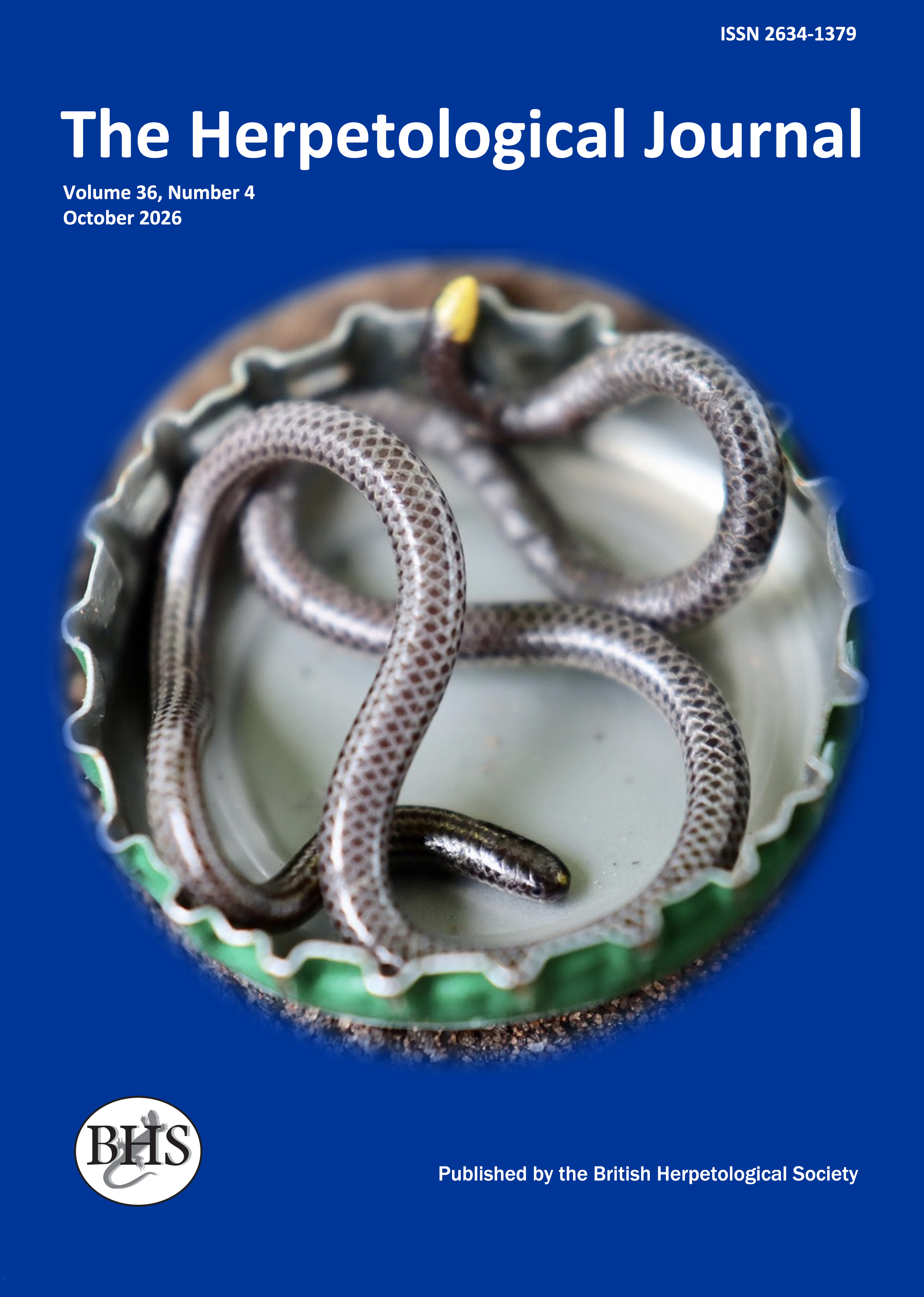
Latest Issue
IMPORTANT NOTE - JUNE 2020
Please note that as from Volume 31 Number 1 (January 2021) on, the Herpetological Journal will be available as an online publication only - the last print edition will be Volume 30 Number 4.
Aligning with this change, it is now no longer possible to purchase a subscription that includes a print copy of the HJ. All members who have existing HJ print subscriptions that remain active as at end June 2020 will receive the full four 2020 print editions. New subscribers or renewals after this time will only have option to subscribe to the online only subscription package. Subscription pricing has been amended to reflect the content changes.