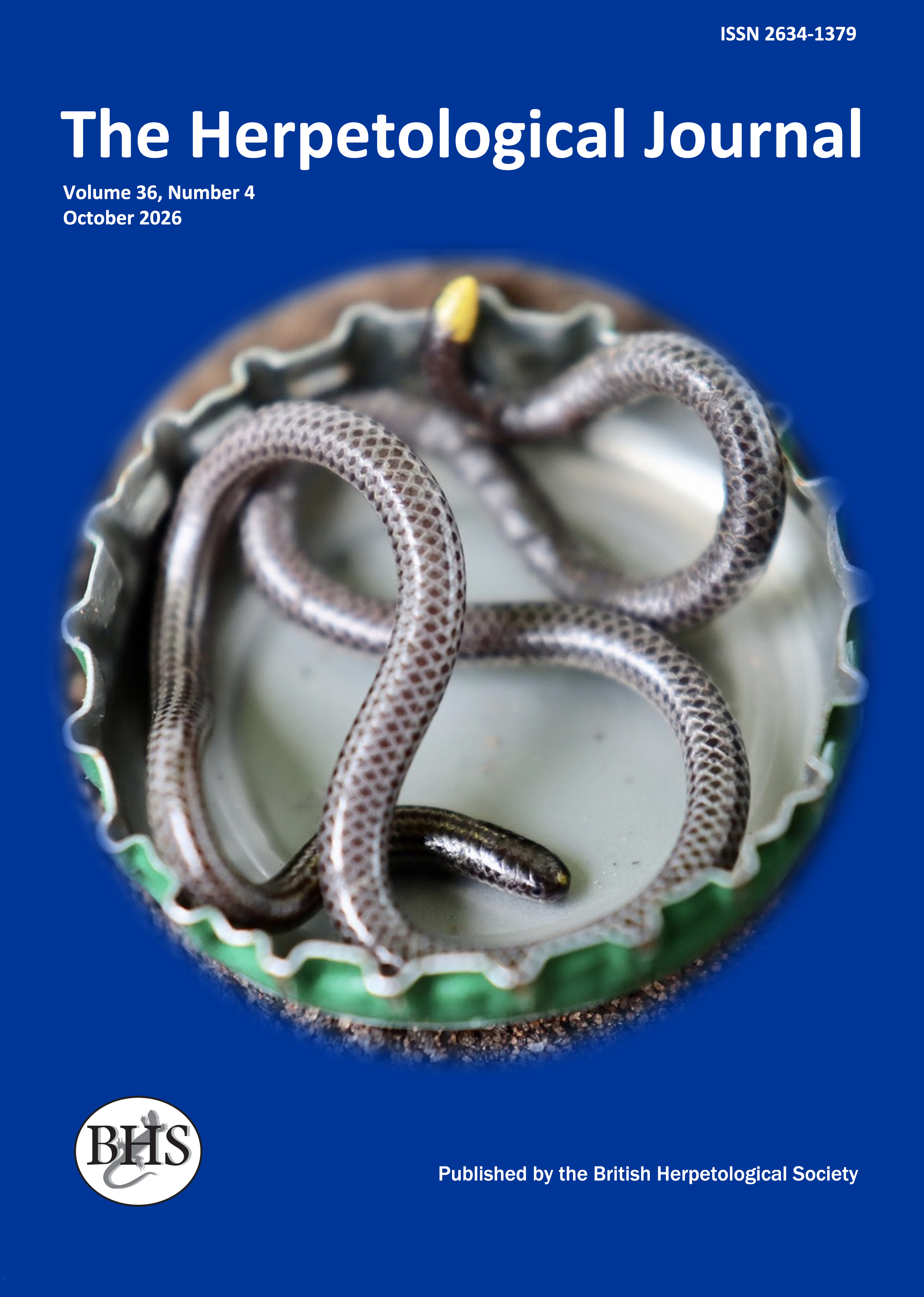
The Herpetological Journal is the Society's prestigious quarterly scientific journal. Articles are listed in Biological Abstracts, Current Awareness in Biological Sciences,Current Contents, Science Citation Index, and Zoological Record.

ISSN 0268-0130

2023 Impact Factor for the Herpetological Journal is 1.1, with the Journal sitting just below Quartile 2 in Zoology, at percentile 46.9


Volume 36, Number 4, October 2026 Volume 36, Number 4, October 2026


01. Predicting habitat suitability and distribution patterns of Epictia borapeliotes (Leptotyphlopidae: Epictinae) using ecological niche modelling

3 downloads

Subscription / purchase required

DOI: https://doi.org/10.33256/36.4.224236

pp. 224-236

Authors: Roberta R. Pinto, Samuel C. Ribeiro, Átilas R. Sousa & Robson W. Ávila

Abstract: Epictia borapeliotes is a fossorial blind snake endemic to north-eastern Brazil. Despite its ecological role as a specialised predator of social insects, its occupancy patterns and the environmental drivers within the Caatinga and Atlantic Forest biomes remain poorly understood due to its cryptic lifestyle. This study reassessed the species' geographic distribution, expanded the knowledge of its morphological variation, and identified areas of environmental suitability through Ecological Niche Modelling (ENM). Based on a dataset of 135 individuals and 42 filtered occurrence points, seven modelling algorithms were correlated with 11 bioclimatic and topographic variables. Results indicate a broad distribution across the Brazilian Northeast, encompassing approximately 100,000 – 140,000 km² across Caatinga, Atlantic Forest and urban zones, suggesting high habitat plasticity. ENM showed high predictive performance (TSS = 0.87; ROC = 0.89) and identified peak habitat suitability in the eastern Borborema Plateau and eastern Rio Grande do Norte. Habitat suitability was primarily driven by annual temperature range (Bio7), isothermality (Bio3), precipitation seasonality (Bio15) and terrain slope, with optimal conditions occurring on moderate slopes (mean ~8°) that provide stable thermal gradients and favourable conditions for prey availability. Models incorporating ENVIREM predictors expanded the estimated suitable area by approximately 43%, highlighting the importance of energy-water balance variables – such as potential evapotranspiration and climatic moisture index – in shaping the species’ ecological niche. Despite occurring across a range of rainfall regimes, Epictia borapeliotes appears to depend on thermally stable environments to maintain its biological functions. These findings provide a spatial framework for targeted surveys and reveal a substantial mismatch between suitable habitat and protected areas, offering key insights for conservation planning of fossorial fauna in seasonal tropical ecosystems.

Keywords: Scolecophidia, epictini, geographic distribution, ecological variation, snakes


02. Population genetic structure of a Colombian endemic poison frog Dendrobates truncatus (Anura: Dendrobatidae): A contribution to its conservation

2 downloads

Subscription / purchase required

DOI: https://doi.org/10.33256/36.4.237248

pp. 237-248

Authors: Mario Vargas-Ramírez, Sabine Nürnberg & Raffael Ernst

Abstract: The yellow-striped poison frog Dendrobates truncatus is endemic to Colombia. Despite its ecological plasticity and apparent abundance, which led to its classification as Least Concern (LC) on the IUCN Red List, it is crucial to objectively assess its conservation status, as the species faces significant threats from habitat modification and destruction, as well as the pet trade. Conservation genetics and phylogeographic approaches can provide valuable insights for such evaluation. To this end, multiple populations across the species' distribution range were genetically analysed using mitochondrial DNA sequences (Cytochrome b) and nuclear DNA markers (microsatellite loci). While mitochondrial data revealed phylogeographic structure with three main genetic groups, nuclear data revealed three or five populations across the species' distribution range. Both markers indicated clear population structure, high genetic diversity and evidence of population expansion. This genetic structure likely results from a combination of ecological, biogeographical and anthropogenic factors. The identified populations represent independent management units, underscoring the need for tailored conservation strategies. These findings provide a foundation for further research and the development of effective management and conservation strategies for the species’ populations.

Keywords: conservation, haplotype network, microsatellites, mitochondrial DNA, population expansion, phylogeography


03. Haematological study of freshwater turtles from anthropogenically impacted and non-disturbed environments of Argentina

1 download

Subscription / purchase required

DOI: https://doi.org/10.33256/36.4.249260

pp. 249-260

Authors: Rocío M. Sánchez & Leandro Alcalde

Abstract: Haematological studies provide valuable information on the health condition of wild populations and can serve as indicators of environmental stress. The present study evaluated the effects of water quality on the haematological parameters of two freshwater turtle species, Hydromedusa tectifera and Phrynops hilarii, across streams with contrasting land use (urban and rural) in Buenos Aires province, Argentina. Fieldwork was conducted during the austral spring and summer between 2016 and 2018. Blood samples were collected from 57 adult H. tectifera and 26 adult P. hilarii of both sexes to perform direct counts of red and white blood cells (RBC and WBC), determine the leucocyte profile and calculate the heterophils/lymphocytes (H/L) stress index.

Both species exhibited the leucocyte types typical of turtles (heterophils, eosinophils, lymphocytes, monocytes and basophils), with no marked interspecific morphological differences. Water quality significantly influenced immune cell profiles in both species: percentages of heterophils (%H) were significantly higher in turtles from impacted urban sites than in those from rural low-impact sites, whereas percentages of eosinophils (%E) were significantly lower in individuals from urban high-impact streams (and in P. hilarii also from rural moderate-impact streams) compared with those from rural low-impact sites. Monocyte percentages (%M) were significantly higher in individuals of both species from rural moderate-impact sites. In H. tectifera, males showed significantly higher RBC counts and lymphocyte percentages (%L), and lower %M, than females. This study provides the first description of the haematological parameters of H. tectifera and the first assessment of these parameters in wild populations of P. hilarii. The reference values reported here provide a useful baseline for future conservation and long-term monitoring of wild populations of both species.

Keywords: red blood cells, white blood cells, leucocyte profile, Hydromedusa tectifera, Phrynops hilarii


04. Recurrent bycatch of immature green turtles by small-scale fisheries on the Amazon coast

2 downloads

Subscription / purchase required

DOI: https://doi.org/10.33256/36.4.261266

pp. 261-266

Authors: Tamires de A.P. de Oliveira, Ana Laura P. Santos, Jéssica M. San-Martin, Daniely Félix-Silva, Josie Figueiredo & Juarez C.B. Pezzuti

Abstract: Knowledge of habitat use by immature stages of marine megafauna remains limited, particularly in regions with scarce records. Along the Amazon coast, the occurrence of immature Chelonia mydas has been documented only through isolated records, leaving unclear whether the species uses this region sporadically or as a regular habitat. This study aimed to investigate incidental captures of green turtles through five-year collaborative research with artisanal fishers in two Environmental Protection Areas in northern Brazil. Between 2017 and 2021, 153 individuals were recorded, the majority being juveniles and subadults. Captures occurred in both estuarine and marine habitats, with no significant differences in body size among years or between environments. Most captures were concentrated between March and July. Recapture data (n = 13) indicated short to moderate intervals between captures (median = 13 days; IQR: 10–150), suggesting repeated use of the area by some individuals. The consistent occurrence of immature turtles across multiple years and seasons indicates that the Amazon coast is not used only sporadically. Instead, the recurrent records indicate continuous use of the area and suggest that it may serve as a developmental or foraging habitat for C. mydas. These results provide novel baseline information for a poorly studied region and highlight the importance of Amazonian coastal ecosystems for the conservation of green turtles in the South Atlantic.

Keywords: Chelonia mydas, Amazon estuary, mangroves, foraging ground


04a. Supplementary material for 04. Recurrent bycatch of immature green turtles by small-scale fisheries on the Amazon coast

2 downloads

Subscription / purchase required

Authors: Tamires de A.P. de Oliveira, Ana Laura P. Santos, Jéssica M. San-Martin, Daniely Félix-Silva, Josie Figueiredo & Juarez C.B. Pezzuti


05. Mating aggregation in the blind snake Amerotyphlops brongersmianus, with comments on the evolution of mating tactics in Scolecophidia

7 downloads

Open Access

DOI: https://doi.org/10.33256/36.4.267272

pp. 267-272

Authors: Henrique Bartolomeu Braz & Selma Maria Almeida-Santos

Abstract: Snakes exhibit two primary tactics during the breeding season: male-male combat and non-agonistic aggregations around reproductive females. However, the mating tactics of many species, particularly within the earliest-diverging snake lineages, remain poorly known. This knowledge gap hinders our understanding of the evolution of snake mating systems. Here, we document a multi-male/multi-female aggregation involving five males and two females of the South American striped blind snake, Amerotyphlops brongersmianus (Typhlopidae: Scolecophidia). Both females subsequently laid fertile eggs, thus confirming recent mating activity. We then critically reviewed literature reports of aggregation in scolecophidians to explore the evolution of mating tactics. We found various instances of mating aggregations in scolecophidians, indicating that this tactic is widespread within the group. We propose that mating aggregation is ancestral in Scolecophidia and evolved early in the evolutionary history of snakes. We encourage researchers to be vigilant and report observations of mating aggregations in snakes, especially in poorly known fossorial lineages. These records will help complement and validate current knowledge of reproductive behaviour and allow for testing the hypotheses proposed here.

Keywords: reproductive behaviour, courtship, fossorial snake, sexual aggregation, mating system


06. New record of a species of the Scinax nasicus group (Anura: Hylidae) in the Brazilian Pampa biome

1 download

Subscription / purchase required

DOI: https://doi.org/10.33256/36.4.273278

pp. 273-278

Authors: Teilor Carvalho Koscrevic, Amanda Jamille Carvalho Brum, Arley Camargo & Tiago Gomes dos Santos

Abstract: Scinax represents a diverse genus widely distributed throughout the Neotropical region. In this study, we report the occurrence of a member of the Scinax nasicus group in the municipality of São Borja, on the western border of Rio Grande do Sul with Argentina, representing the first record of this lineage for the Brazilian Pampa biome. Mitochondrial DNA data were used to assess the taxonomic identity of the newly recorded population, while morphometric comparisons with morphologically similar species occurring in the region provided complementary evidence. The specimens formed a well-supported phylogenetic lineage associated with conspecific sequences available from other portions of the species’ distribution. This finding represents the first record of a member of the S. nasicus group for the Brazilian Pampa and extends the known southern distribution limit of the identified species by approximately 133 km. The record highlights the importance of continued inventories in the western border region of Rio Grande do Sul and contributes to a better understanding of amphibian diversity in southern South America.

Keywords: Amphibian diversity, hylid frog, extension occurrence, Rio Grande do Sul, grassland ecosystems


06a. Supplementary material for 06. New record of a species of the Scinax nasicus group (Anura: Hylidae) in the Brazilian Pampa biome

1 download

Subscription / purchase required

Authors: Teilor Carvalho Koscrevic, Amanda Jamille Carvalho Brum, Arley Camargo & Tiago Gomes dos Santos


07. Integrative morphometric and body condition analysis of Geochelone elegans (Schoepff, 1795) with a species-specific predictive equation for body mass

2 downloads

Subscription / purchase required

DOI: https://doi.org/10.33256/36.4.279287

pp. 279-287

Authors: Josip Miljković, Kristina Popović, Simon Cirkulan, Igor Bošnjak, Kristijan Ovari, Milena Mičić, Tvrtko Mataušić, Ana Shek Vugrovečki, Ksenija Vlahović, Ivona Žura Žaja, Marko Samardžija & Dražen Đuričić

Abstract: The Indian star tortoise Geochelone elegans, a vulnerable species listed under CITES, is distributed across India, Sri Lanka and parts of Pakistan. Assessing body condition is a fundamental component of reptile health evaluation, with Body Condition Score (BCS) representing the most widely used metric for this purpose. This study assessed body condition in 69 Indian star tortoises (55 adults and 14 juveniles) confiscated at the Croatian border and subsequently housed in five institutions in Croatia, Slovenia and Serbia. Body mass differed significantly between sexes and locations, with sex-related differences varying among facilities. Two-way ANOVA revealed significant effects of sex (F = 12.35; p = 0.0012), location (F = 7.80; p = 0.0034), and their interaction (F = 3.21; p = 0.0417) on body mass. For the first time, a morphometry-based equation was developed to estimate body volume in this species, allowing determination of mean body density (approximately 650 kg/m³). A novel equation for body mass estimation was derived, showing a strong positive correlation with measured mass (r = 0.923). Body condition assessment may be influenced by physiological and environmental factors such as hydration status, temperature, diet, and seasonal variation, while the reliability of BCS also depends on observer expertise. Standardised protocols, staff training and validation using wild populations and physiological parameters are recommended.

Keywords: Indian star tortoise, body condition score, body density, body weight, predictive model


08. Baseline prevalence of Batrachochytrium dendrobatidis in a Central African rainforest amphibian community

7 downloads

Open Access

DOI: https://doi.org/10.33256/36.4.288297

pp. 288-297

Authors: Joseph J. Madden, Emily Forner, Patrick S. Champagne, Sverre Finney, Hermine Ina, Pierre Massala, Joris-Bloy Ngoulou, Abraham G. Bamba-Kaya, Gregory F.M. Jongsma, Kelly R. Zamudio & Edmund W. Basham

Abstract: Batrachochytrium dendrobatidis (Bd), the fungal pathogen that causes chytridiomycosis, has been implicated in severe amphibian population declines and extinctions globally, yet the pathogen’s distribution in Central Africa remains poorly documented. Gabon hosts exceptional amphibian diversity, but previous Bd surveys have been sparse or geographically restricted. We establish a baseline of Bd occurrence in Ngounié province, southern Gabon, by screening 276 adults, representing 57 species of anurans. Prevalence of Bd was 11.2% overall (31 individuals, 18 species). We report the first Bd detections in Gabon for Cardioglossa leucomystax and Leptopelis notatus, and the first global Bd records for Amnirana amnicola and Arthroleptis taeniatus. Infection was strongly associated with adult ecology: semi-aquatic and aquatic species showed significantly higher prevalence than arboreal or terrestrial taxa. Infection intensity was generally low, though one Hyperolius tuberculatus individual exhibited a very high load (> 5 × 10⁵ ITS copies) without visible signs of disease. We confirm Bd presence in southern Gabon and highlight aquatic habitats as Bd hotspots, providing baseline data for future monitoring and conservation in the region.

Keywords: Chytridiomycosis, Gabon, frog, reproductive mode, amphibian disease 

Résumé: Batrachochytrium dendrobatidis (Bd), l'agent fongique responsable de la chytridiomycose, a provoqué un déclin important et l'extinction de populations d'amphibiens du globe, mais la répartition de cet agent pathogène en Afrique centrale reste mal documentée. Le Gabon abrite une diversité exceptionnelle d'amphibiens, mais les études antérieures sur le Bd ont été rares ou géographiquement limitées. Nous établissons une base de référence de la présence du Bd dans la province de Ngounié, au sud du Gabon, en examinant 276 adultes, représentant 57 espèces d'anoures. La prévalence du Bd était de 11,2 % dans l'ensemble (31 individus, 18 espèces). Nous signalons les premières détections de Bd au Gabon pour les espèces Cardioglossa leucomystax et Leptopelis notatus, et les premières observations mondiales de Bd pour Amnirana amnicola et Arthroleptis taeniatus. L'infection était fortement associée à l'écologie des adultes: les espèces semi-aquatiques et aquatiques présentaient une prévalence significativement plus élevée que les arboricoles ou terrestres. L'intensité de l'infection était généralement faible, bien qu'un individu Hyperolius tuberculatus ait présenté une charge très élevée ( > 5 × 10⁵ copies ITS) sans symptômes visibles de la maladie. Nous confirmons la présence de Bd dans le sud du Gabon et soulignons que les habitats aquatiques sont des zones sensibles au Bd, fournissant ainsi des données de référence pour la surveillance et la conservation futures dans la région.


08a. Supplementary material for 08. Baseline prevalence of Batrachochytrium dendrobatidis in a Central African rainforest amphibian community

5 downloads

Open Access

Authors: Joseph J. Madden, Emily Forner, Patrick S. Champagne, Sverre Finney, Hermine Ina, Pierre Massala, Joris-Bloy Ngoulou, Abraham G. Bamba-Kaya, Gregory F.M. Jongsma, Kelly R. Zamudio & Edmund W. Basham


08b. Supplementary material for 08. Baseline prevalence of Batrachochytrium dendrobatidis in a Central African rainforest amphibian community

6 downloads

Open Access

Authors: Joseph J. Madden, Emily Forner, Patrick S. Champagne, Sverre Finney, Hermine Ina, Pierre Massala, Joris-Bloy Ngoulou, Abraham G. Bamba-Kaya, Gregory F.M. Jongsma, Kelly R. Zamudio & Edmund W. Basham


09. Reproductive biology of Hemidactylus agrius (Vanzolini, 1978) in the Caatinga of Paraíba, Brazil

1 download

Subscription / purchase required

DOI: https://doi.org/10.33256/36.4.298311

pp. 298-311

Authors: Alexandre Pereira Dantas, Janaina Cardoso Roque, Luciana Kelly de Sousa Silva, Leonardo Pessoa Cabus Oitaven, Marcio Frazão Chaves & Geraldo Jorge Barbosa de Moura

Abstract: This study evaluated the influence of somatic indices and climatic variables on the gametogenesis of Hemidactylus agrius in a semi-arid Caatinga population, north-eastern Brazil. A total of 61 specimens were collected during monthly field surveys conducted between July 2023 and June 2024. Reproductive dynamics were assessed through histological analyses and the calculation of body condition (K1), gonadosomatic (RLG) and hepatosomatic (RLW) indices in relation to environmental variables. Morphometric data revealed clear sexual dimorphism, with females displaying a larger body size and higher K1 and RLW values, suggesting greater energetic investment in reproduction. Histological evidence showed the presence of all stages of the germ cell lineage in reproductively active individuals throughout the year, supporting continuous gametogenic activity. Somatic indices showed low temporal variation, and precipitation was not significantly correlated with reproductive parameters. In contrast, temperature exerted a significant negative effect on both RLG and RLW, suggesting that increased metabolic demands under warmer conditions may modulate reproductive intensity. These findings indicate that H. agrius maintains year-round reproductive activity with low seasonality. This pattern is consistent with life-history strategies in semi-arid environments, where environmental unpredictability may favour continuous reproductive readiness.

Keywords: gonadosomatic index, hepatosomatic index, histology, reproductive cycles, lizards


Download Access:

The latest 8 issues can be downloaded when logged in with a Herpetological Journal subscription membership.

Individual articles can be purchased for download.

Older issues and occasional Open Access articles are available for public download

Submissions:

For further information and submission guidelines please see our Journal Instructions to Authors

BHS Ethics Policy

IMPORTANT NOTE - JUNE 2020

Please note that as from Volume 31 Number 1 (January 2021) on, the Herpetological Journal will be available as an online publication only - the last print edition will be Volume 30 Number 4.   

Aligning with this change, it is now no longer possible to purchase a subscription that includes a print copy of the HJ.  All members who have existing HJ print subscriptions that remain active as at end June 2020 will receive the full four 2020 print editions.  New subscribers or renewals after this time will only have option to subscribe to the online only subscription package.  Subscription pricing has been amended to reflect the content changes.


Search Publications