

The Herpetological Journal
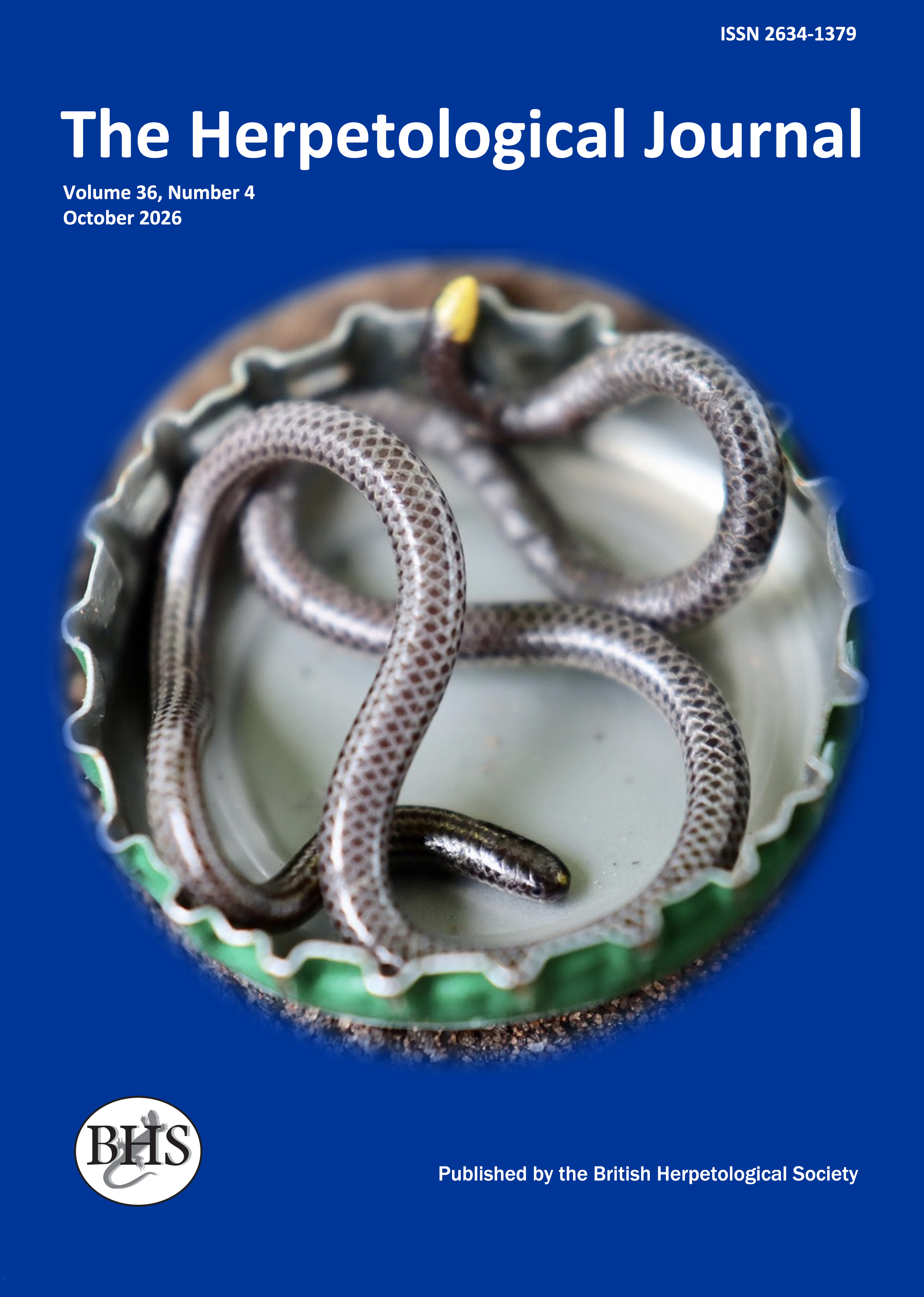
The Herpetological Journal is the Society's prestigious quarterly scientific journal. Articles are listed in Biological Abstracts, Current Awareness in Biological Sciences,Current Contents, Science Citation Index, and Zoological Record.
ISSN 0268-0130
2023 Impact Factor for the Herpetological Journal is 1.1, with the Journal sitting just below Quartile 2 in Zoology, at percentile 46.9
08. Baseline prevalence of Batrachochytrium dendrobatidis in a Central African rainforest amphibian community
9 downloads
Open Access
DOI: https://doi.org/10.33256/36.4.288297
pp. 288-297
Authors: Joseph J. Madden, Emily Forner, Patrick S. Champagne, Sverre Finney, Hermine Ina, Pierre Massala, Joris-Bloy Ngoulou, Abraham G. Bamba-Kaya, Gregory F.M. Jongsma, Kelly R. Zamudio & Edmund W. Basham
Abstract: Batrachochytrium dendrobatidis (Bd), the fungal pathogen that causes chytridiomycosis, has been implicated in severe amphibian population declines and extinctions globally, yet the pathogen’s distribution in Central Africa remains poorly documented. Gabon hosts exceptional amphibian diversity, but previous Bd surveys have been sparse or geographically restricted. We establish a baseline of Bd occurrence in Ngounié province, southern Gabon, by screening 276 adults, representing 57 species of anurans. Prevalence of Bd was 11.2% overall (31 individuals, 18 species). We report the first Bd detections in Gabon for Cardioglossa leucomystax and Leptopelis notatus, and the first global Bd records for Amnirana amnicola and Arthroleptis taeniatus. Infection was strongly associated with adult ecology: semi-aquatic and aquatic species showed significantly higher prevalence than arboreal or terrestrial taxa. Infection intensity was generally low, though one Hyperolius tuberculatus individual exhibited a very high load (> 5 × 10⁵ ITS copies) without visible signs of disease. We confirm Bd presence in southern Gabon and highlight aquatic habitats as Bd hotspots, providing baseline data for future monitoring and conservation in the region.
Keywords: Chytridiomycosis, Gabon, frog, reproductive mode, amphibian disease
Résumé: Batrachochytrium dendrobatidis (Bd), l'agent fongique responsable de la chytridiomycose, a provoqué un déclin important et l'extinction de populations d'amphibiens du globe, mais la répartition de cet agent pathogène en Afrique centrale reste mal documentée. Le Gabon abrite une diversité exceptionnelle d'amphibiens, mais les études antérieures sur le Bd ont été rares ou géographiquement limitées. Nous établissons une base de référence de la présence du Bd dans la province de Ngounié, au sud du Gabon, en examinant 276 adultes, représentant 57 espèces d'anoures. La prévalence du Bd était de 11,2 % dans l'ensemble (31 individus, 18 espèces). Nous signalons les premières détections de Bd au Gabon pour les espèces Cardioglossa leucomystax et Leptopelis notatus, et les premières observations mondiales de Bd pour Amnirana amnicola et Arthroleptis taeniatus. L'infection était fortement associée à l'écologie des adultes: les espèces semi-aquatiques et aquatiques présentaient une prévalence significativement plus élevée que les arboricoles ou terrestres. L'intensité de l'infection était généralement faible, bien qu'un individu Hyperolius tuberculatus ait présenté une charge très élevée ( > 5 × 10⁵ copies ITS) sans symptômes visibles de la maladie. Nous confirmons la présence de Bd dans le sud du Gabon et soulignons que les habitats aquatiques sont des zones sensibles au Bd, fournissant ainsi des données de référence pour la surveillance et la conservation futures dans la région.
Download Access:
The latest 8 issues can be downloaded when logged in with a Herpetological Journal subscription membership.
Individual articles can be purchased for download.
Older issues and occasional Open Access articles are available for public download
Submissions:
For further information and submission guidelines please see our Journal Instructions to Authors

Latest Issue
IMPORTANT NOTE - JUNE 2020
Please note that as from Volume 31 Number 1 (January 2021) on, the Herpetological Journal will be available as an online publication only - the last print edition will be Volume 30 Number 4.
Aligning with this change, it is now no longer possible to purchase a subscription that includes a print copy of the HJ. All members who have existing HJ print subscriptions that remain active as at end June 2020 will receive the full four 2020 print editions. New subscribers or renewals after this time will only have option to subscribe to the online only subscription package. Subscription pricing has been amended to reflect the content changes.