

The Herpetological Journal
The Herpetological Journal is the Society's prestigious quarterly scientific journal. Articles are listed in Biological Abstracts, Current Awareness in Biological Sciences,Current Contents, Science Citation Index, and Zoological Record.
ISSN 0268-0130
2023 Impact Factor for the Herpetological Journal is 1.1, with the Journal sitting just below Quartile 2 in Zoology, at percentile 46.9
04. Recurrent bycatch of immature green turtles by small-scale fisheries on the Amazon coast
2 downloads
Subscription / purchase required
DOI: https://doi.org/10.33256/36.4.261266
pp. 261-266
Authors: Tamires de A.P. de Oliveira, Ana Laura P. Santos, Jéssica M. San-Martin, Daniely Félix-Silva, Josie Figueiredo & Juarez C.B. Pezzuti
Abstract: Knowledge of habitat use by immature stages of marine megafauna remains limited, particularly in regions with scarce records. Along the Amazon coast, the occurrence of immature Chelonia mydas has been documented only through isolated records, leaving unclear whether the species uses this region sporadically or as a regular habitat. This study aimed to investigate incidental captures of green turtles through five-year collaborative research with artisanal fishers in two Environmental Protection Areas in northern Brazil. Between 2017 and 2021, 153 individuals were recorded, the majority being juveniles and subadults. Captures occurred in both estuarine and marine habitats, with no significant differences in body size among years or between environments. Most captures were concentrated between March and July. Recapture data (n = 13) indicated short to moderate intervals between captures (median = 13 days; IQR: 10–150), suggesting repeated use of the area by some individuals. The consistent occurrence of immature turtles across multiple years and seasons indicates that the Amazon coast is not used only sporadically. Instead, the recurrent records indicate continuous use of the area and suggest that it may serve as a developmental or foraging habitat for C. mydas. These results provide novel baseline information for a poorly studied region and highlight the importance of Amazonian coastal ecosystems for the conservation of green turtles in the South Atlantic.
Keywords: Chelonia mydas, Amazon estuary, mangroves, foraging ground
Download Access:
The latest 8 issues can be downloaded when logged in with a Herpetological Journal subscription membership.
Individual articles can be purchased for download.
Older issues and occasional Open Access articles are available for public download
Submissions:
For further information and submission guidelines please see our Journal Instructions to Authors

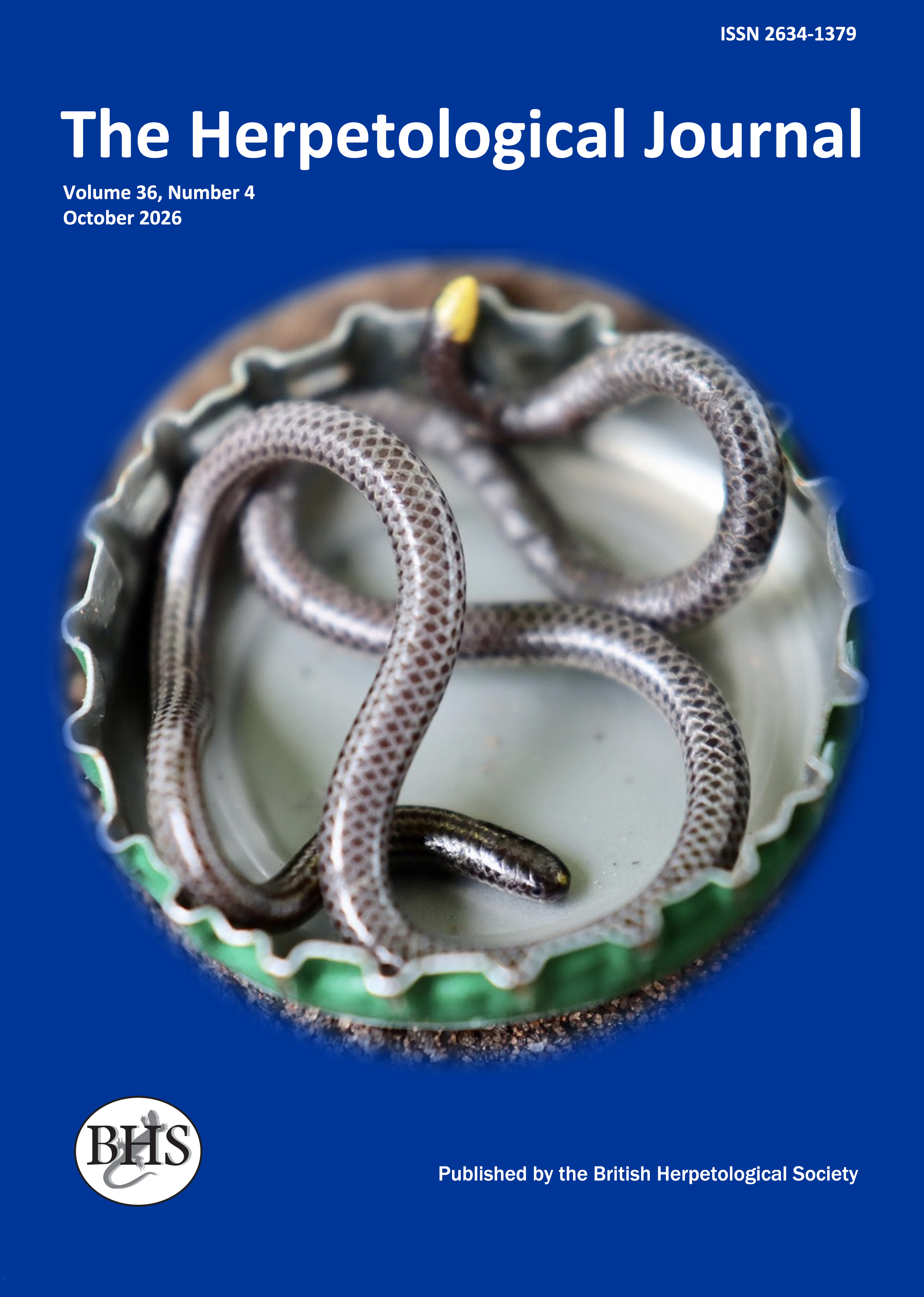
Latest Issue
IMPORTANT NOTE - JUNE 2020
Please note that as from Volume 31 Number 1 (January 2021) on, the Herpetological Journal will be available as an online publication only - the last print edition will be Volume 30 Number 4.
Aligning with this change, it is now no longer possible to purchase a subscription that includes a print copy of the HJ. All members who have existing HJ print subscriptions that remain active as at end June 2020 will receive the full four 2020 print editions. New subscribers or renewals after this time will only have option to subscribe to the online only subscription package. Subscription pricing has been amended to reflect the content changes.