

The Herpetological Journal
The Herpetological Journal is the Society's prestigious quarterly scientific journal. Articles are listed in Biological Abstracts, Current Awareness in Biological Sciences,Current Contents, Science Citation Index, and Zoological Record.
ISSN 0268-0130
2023 Impact Factor for the Herpetological Journal is 1.1, with the Journal sitting just below Quartile 2 in Zoology, at percentile 46.9
01. Updated assessment of population size and habitat of the Critically Endangered frog Boophis williamsi (Guibé, 1974) in Madagascar’s central highlands
945 downloads
Open Access
DOI: https://doi.org/10.33256/36.2.8797
pp. 87-97
Authors: Rebecca De Salem E. Fanomezantsoa, Nirhy H.C. Rabibisoa, Sam Hyde Roberts & Devin A. Edmonds
Abstract: Amphibians are among the most threatened vertebrates, yet many species lack the ecological and demographic data needed to implement effective conservation measures, especially in tropical regions. William’s bright-eyed frog Boophis williamsi is one of Madagascar’s most highly threatened frog species, being restricted to a small area of the Ankaratra Massif in the central highlands. We conducted fieldwork during 2018, 2019 and 2021 to identify habitat associations across life stages and estimate abundance along ten stream transects. Our results confirmed B. williamsi presence at seven localities within a small area of only a few square kilometres, the only location the species is known to occur. Habitat associations varied by life stage, with tadpoles more often found in shaded, rocky streams within humid montane forest, while adults were more often found along rocky streams in open savanna habitats. Overall, streams were shallow (0.18–0.83 m), cool (7.70–17.80 °C), and often slightly alkaline (pH 6.70–8.26). Using N-mixture models, we estimated fewer than 600 individuals (tadpoles and frogs combined) across four surveyed stream transects during the 2018–2019 austral summer. Detection probabilities for frogs were seasonally variable, peaking in December at the onset of the rainy season. Conversely, tadpoles had higher and relatively constant detectability across September, December and March. Despite ongoing threats from deforestation and fire, B. williamsi persists at Ankaratra, likely aided by recent conservation efforts. We recommend the development of a standardised, long-term monitoring protocol incorporating both tadpoles and frogs, as well as increased protection of high-elevation forests near stream habitats that support this imperilled species.
Keywords: amphibian conservation, Ankaratra, biodiversity conservation, detection probability, range-restricted species
Download Access:
The latest 8 issues can be downloaded when logged in with a Herpetological Journal subscription membership.
Individual articles can be purchased for download.
Older issues and occasional Open Access articles are available for public download
Submissions:
For further information and submission guidelines please see our Journal Instructions to Authors

Latest Issue
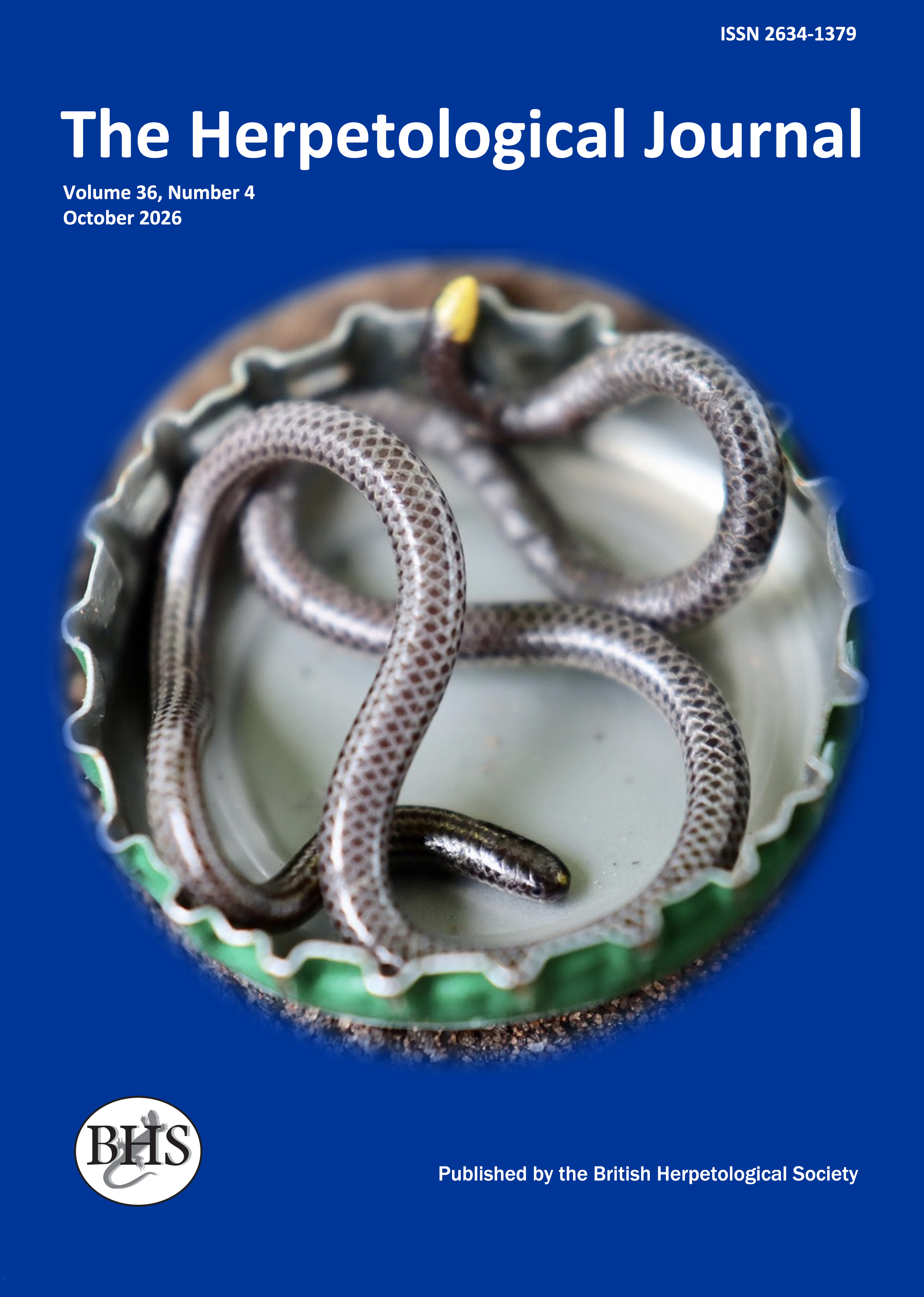
IMPORTANT NOTE - JUNE 2020
Please note that as from Volume 31 Number 1 (January 2021) on, the Herpetological Journal will be available as an online publication only - the last print edition will be Volume 30 Number 4.
Aligning with this change, it is now no longer possible to purchase a subscription that includes a print copy of the HJ. All members who have existing HJ print subscriptions that remain active as at end June 2020 will receive the full four 2020 print editions. New subscribers or renewals after this time will only have option to subscribe to the online only subscription package. Subscription pricing has been amended to reflect the content changes.