The Herpetological Journal is the Society's prestigious quarterly scientific journal. Articles are listed in Biological Abstracts, Current Awareness in Biological Sciences,Current Contents, Science Citation Index, and Zoological Record.

ISSN 0268-0130

2023 Impact Factor for the Herpetological Journal is 1.1, with the Journal sitting just below Quartile 2 in Zoology, at percentile 46.9


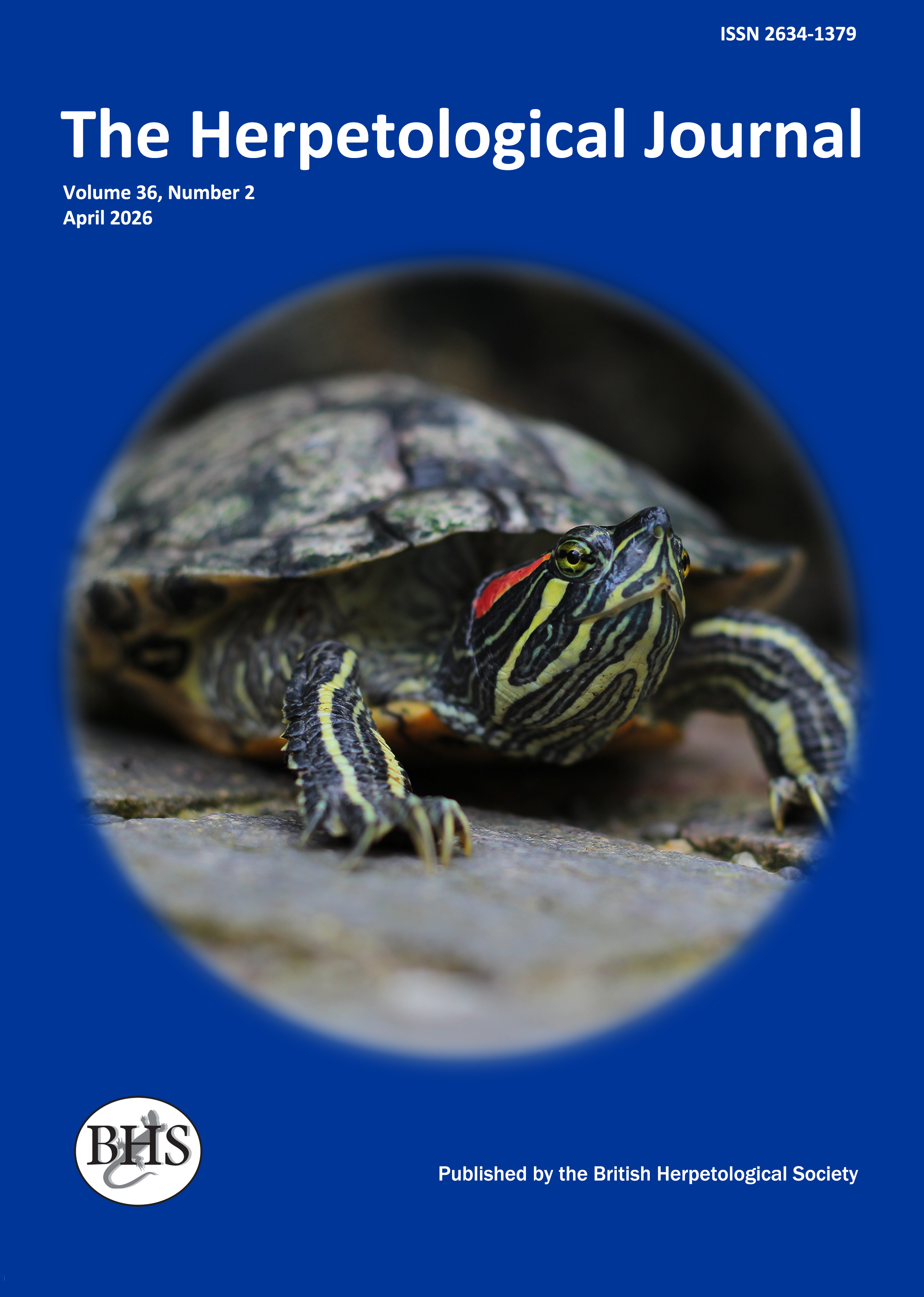
Volume 36, Number 2, April 2026 Volume 36, Number 2, April 2026


01. Updated assessment of population size and habitat of the Critically Endangered frog Boophis williamsi (Guibé, 1974) in Madagascar’s central highlands

13 downloads

Open Access

DOI: https://doi.org/10.33256/36.2.8797

pp. 87-97

Authors: Rebecca De Salem E. Fanomezantsoa, Nirhy H.C. Rabibisoa, Sam Hyde Roberts & Devin A. Edmonds

Abstract: Amphibians are among the most threatened vertebrates, yet many species lack the ecological and demographic data needed to implement effective conservation measures, especially in tropical regions. William’s bright-eyed frog Boophis williamsi is one of Madagascar’s most highly threatened frog species, being restricted to a small area of the Ankaratra Massif in the central highlands. We conducted fieldwork during 2018, 2019 and 2021 to identify habitat associations across life stages and estimate abundance along ten stream transects. Our results confirmed B. williamsi presence at seven localities within a small area of only a few square kilometres, the only location the species is known to occur. Habitat associations varied by life stage, with tadpoles more often found in shaded, rocky streams within humid montane forest, while adults were more often found along rocky streams in open savanna habitats. Overall, streams were shallow (0.18–0.83 m), cool (7.70–17.80 °C), and often slightly alkaline (pH 6.70–8.26). Using N-mixture models, we estimated fewer than 600 individuals (tadpoles and frogs combined) across four surveyed stream transects during the 2018–2019 austral summer. Detection probabilities for frogs were seasonally variable, peaking in December at the onset of the rainy season. Conversely, tadpoles had higher and relatively constant detectability across September, December and March. Despite ongoing threats from deforestation and fire, B. williamsi persists at Ankaratra, likely aided by recent conservation efforts. We recommend the development of a standardised, long-term monitoring protocol incorporating both tadpoles and frogs, as well as increased protection of high-elevation forests near stream habitats that support this imperilled species.

Keywords: amphibian conservation, Ankaratra, biodiversity conservation, detection probability, range-restricted species


02. Distribution of released pet turtles in the UK: a citizen science survey

10 downloads

Open Access

DOI: https://doi.org/10.33256/36.2.98110

pp. 98-110

Authors: Suzie M. Simpson & Richard A. Griffiths

Abstract: Non-native freshwater turtles have established in numerous countries globally, through accidental or deliberate release by pet owners. Long-term monitoring is an important part of management practices considering potential impacts to native fauna and flora. In 2018, a citizen science project (Turtle Tally UK) was initiated to investigate the distribution, numbers and species of released pet turtles in the UK. Data collected between 2019–2023 were analysed comprising 832 reports by 795 participants. In total, 1,387 individual turtles were reported as being seen in the wild over this period. Spatial hotspot analysis showed clustered locations for sightings in London and urban areas of north-west England. From the number of individuals reported, 628 (45%) were verified using photographic evidence submitted by participants. Most verified sightings comprised yellow-bellied sliders (Trachemys scripta scripta, n = 235), red-eared sliders (Trachemys scripta elegans, n = 98) and ‘slider/cooter turtles’ (i.e. Trachemys scripta ssp. and Pseudemys spp., n = 164). Of these verified individuals, 75% were considered lone turtles with the remaining 25% being two or more (max. verified group size = 12, max., unverified group size = 30+). All (except one) were of adult/subadult size including 190 (30%) females, 51 (8%) males and 387 (62%) ‘unknown sex’. Due to the majority being single individuals, the impacts on habitats at a landscape scale are likely to be low, but there may be other risks associated with pathogen pollution and animal welfare. Prohibiting sales of IAS species and natural seasonal mortalities due to the temperate climate could be reducing numbers in the wild but is impeded by the replacement of unregulated species in the pet trade. This focal citizen science project provided a larger dataset over a shorter period and helped to raise public awareness of the issue.

Keywords: chelonia, terrapin, invasive species, wildlife trade


03. Investigating diversity patterns and community dynamics of herpetofauna communities in a small Afrotropical wetland, Uganda

1 download

Subscription / purchase required

DOI: https://doi.org/10.33256/36.2.111124

pp. 111-124

Authors: Mathias Behangana, Raymond Katumba, Jimmy Muheebwa, Achilles Byaruhanga & Luca Luiselli

Abstract: Recent research has increasingly focused on the biodiversity patterns (community structure and diversity metrics) of amphibians and reptiles in tropical African wetlands. In this regard, Uganda is particularly interesting as, despite its relatively small size, it boasts the greatest biodiversity per unit area in Africa and a significant number of endemic vertebrates. The present study aims to analyse the herpetofauna communities of smaller Ugandan wetlands, using the Kaku-Kiyanja wetland (a 20 km² area) as a study case. In order to study the amphibian and reptile communities, we employed a suite of field methods, including visual surveys, dip-netting and audio-call identification, and we evaluated species richness, evenness and diversity patterns in a suite of different habitats. We also used multivariate statistical techniques (Detrended Correspondence Analysis) for spacing the various species in relation to the six type of areas, and a Poisson Generalised Linear Model with a log link to assess the effects of habitat type and taxonomic family on species abundance. A total of 28 sympatric species were identified, comprising 17 amphibian species and 11 reptile species. However, the estimated species richness for reptiles was substantially higher, as indicated by the Chao-1 estimator and species accumulation (saturation) curve analyses. Our GLM results demonstrate that species abundance was strongly shaped by habitat type, with a particular habitat type (IV, i.e. permanent wetland with open water, with scattered Typha and Cyperus papyrus stands) supporting markedly higher counts and Ptychadenidae disproportionately contributing to overall richness patterns across the landscape. GLMs also revealed significant variation in amphibian community diversity metrics—including Shannon diversity, Simpson index, evenness and species richness—across habitats, with some habitats showing lower diversity and higher dominance by a few species. Overall, these results underscore the ecological richness of the studied wetland despite its limited spatial extent. The species diversity observed in Kaku-Kiyanja is comparable to that documented in significantly larger wetland systems. Its ecological connectivity to surrounding water bodies may explain the relatively high species richness. However, we should acknowledge limitations such as suboptimal sampling, particularly for reptiles. Despite no threatened species being found, agricultural activities pose significant threats to the wetland's biodiversity, warranting future conservation efforts.

Keywords: community ecology, Amphibia, Reptilia, diversity metrics, Kaku-Kiyanja wetland, East Africa


04. Discovery of a large communal hibernaculum of the Schmidt's whip snake Dolichophis schmidti in Georgia via social media

1 download

Subscription / purchase required

DOI: https://doi.org/10.33256/36.2.125130

pp. 125-130

Authors: Giorgi Iankoshvili, Ioane Rostiashvili, Andro Solomanashvili, Shota Zandukeli, Alisa Sanakoeva & Mariam Tsulaia

Abstract: Communal hibernation is prevalent among snakes of the temperate zone, however, it remains poorly documented for most species worldwide. We report the first documented interspecific snake hibernaculum in Georgia, identified after a local resident posted on TikTok. In total, we collected 135 snakes from a reinforced septic tank. Of these, 133 were identified as Dolichophis schmidti (Nikolsky, 1909) of different ages, with single specimens of Platyceps najadum (Eichwald, 1831) and Natrix tessellata (Laurenti, 1768). This find represents both the largest recorded aggregation of D. schmidti and the first interspecific snake hibernaculum documented in the Caucasus. The D. schmidti specimens showed a nearly balanced sex ratio with a slight female bias (52.6%) and a wide size range (total length 82–158 cm; mass 82–753 g), indicating multiple cohorts. Snakes occurred in the terminal chamber, where microclimatic conditions were most stable (11 °C). As construction posed an imminent threat, snakes were translocated from the discovery site and released in the spring. Our find demonstrates the importance of anthropogenic structures for successful communal hibernation in human-modified landscapes. This case also highlights the value of social media as an early-warning mechanism for conservation responses.

Keywords: Caucasus, Colubridae, citizen science, reptile behaviour, winter aggregation


04a. Supplementary material for 04. Discovery of a large communal hibernaculum of the Schmidt's whip snake Dolichophis schmidti in Georgia via social media

1 download

Subscription / purchase required

Authors: Giorgi Iankoshvili, Ioane Rostiashvili, Andro Solomanashvili, Shota Zandukeli, Alisa Sanakoeva & Mariam Tsulaia


05. Wandering shells: social media monitoring reveals the scale of exotic tortoise escapes in Poland

6 downloads

Open Access

DOI: https://doi.org/10.33256/36.2.131135

pp. 131-135

Authors: Adriana Kościańska, Ada Krasińska, Ash Wilczek, Mikołaj Kaźmierczak & Krzysztof Kolenda

Abstract: Tortoises are among the most commonly kept exotic pets worldwide. However, they are often housed in inadequate fenced outdoor enclosures, which increases the risk of escape and potential introduction into the natural environment. The aim of this study was to assess the scale of this problem in Poland by analysing Facebook posts reporting missing and found tortoises. In total, 1,060 posts (532 concerning lost and 528 concerning found tortoises) published between 2010 and 2023 were collected. Ten species were identified, with the most frequently recorded being Testudo horsfieldii and Testudo hermanni. At least 43.5% of found individuals were in poor health, often exhibiting signs of carapace deformities, overgrown beaks and claws, as well as injuries such as fractures or open wounds. These findings underscore the need to raise public awareness and implement stricter control measures to prevent further introductions of non-native tortoise species into the Polish environment.

Keywords: alien species, terraristics, Testudo sp., social media, pets


05a. Supplementary material for 05. Wandering shells: social media monitoring reveals the scale of exotic tortoise escapes in Poland

4 downloads

Open Access

Authors: Adriana Kościańska, Ada Krasińska, Ash Wilczek, Mikołaj Kaźmierczak & Krzysztof Kolenda


06. Insights on the sleep ecology of Tropidurus hispidus (Spix, 1825) (Squamata: Tropiduridae)

1 download

Subscription / purchase required

DOI: https://doi.org/10.33256/36.2.136140

pp. 136-140

Authors: Gabriel Spanghero, Josivan Bernardo da Silva, Guarino R. Colli, Daniel Oliveira Mesquita & Thaís B. Guedes

Abstract: We report preliminary data on the sleep ecology of Tropidurus hispidus (Tropiduridae) lizards based on six observations of sleeping lizards in natural settings, and highlight how standard monitoring techniques can be useful to study lizard sleep behaviour. We studied the sleeping habits and substrate use of three adult male lizards, monitored using thread bobbins, along with three adult lizards we found during active search (total n = 6). Monitored and non-monitored lizards were observed sleeping during the night with varied postures at variable heights. Regarding sleeping sites or substrates, we observed for the first time burrowing behaviour in sandy ground under thorny vegetation. Besides the use of the ground, four lizards used woody branches of shrubs for sleeping. We did not observe intraspecific aggregations during the sleep period. These preliminary results indicate that T. hispidus may rely on hiding and thermoregulating during sleep hours, which differs from other lizard lineages that are commonly found sleeping perched in thin vegetation or on leaves. We also highlight that the use of standard monitoring techniques, such as thread bobbins to study lizard sleep behaviour, enhances our understanding of the natural history of lizards and other reptiles.

Keywords: behaviour, Caatinga, lizard, sleeping, tracking


06a. Supplementary material for 06. Insights on the sleep ecology of Tropidurus hispidus (Spix, 1825) (Squamata: Tropiduridae)

1 download

Subscription / purchase required

Authors: Gabriel Spanghero, Josivan Bernardo da Silva, Guarino R. Colli, Daniel Oliveira Mesquita & Thaís B. Guedes


07. Feeding habits, ontogenetic patterns and developmental changes in the adrenal gland of Xenodon merremii

1 download

Subscription / purchase required

DOI: https://doi.org/10.33256/36.2.141145

pp. 141-145

Authors: Gabriel Saturno, Vitor O.F. Assunção & Vanda L. Ferreira

Abstract: Understanding snake diets allows for the assessment of fundamental aspects of their ecological and physiological adaptations. Xenodon merremii consumes toxic prey that are underexplored by most snakes, which raises questions about the basis of this behaviour and its implications during development. In this context, this study investigated the feeding habits of this species from an ontogenetic perspective, exploring potential associations with morphological changes, especially concerning the adrenal glands, by integrating literature data and morphometric analyses. Juveniles presented a more varied diet, including toxic prey, while adults consumed mainly the toxic prey. A proportional increase in adrenal gland volume was observed during growth, suggesting a possible association with the progressive consumption of toxic prey. These findings suggest that changes in the adrenal glands are associated with dietary specialisation, and that feeding behaviour may be a determining factor in the physiological adaptations observed during X. merremii development.

Keywords: diet, anurophagous snakes, specialised diet, morphology, ontogeny


07a. Supplementary material for 07. Feeding habits, ontogenetic patterns and developmental changes in the adrenal gland of Xenodon merremii

1 download

Subscription / purchase required

Authors: Gabriel Saturno, Vitor O.F. Assunção & Vanda L. Ferreira


Download Access:

The latest 8 issues can be downloaded when logged in with a Herpetological Journal subscription membership.

Individual articles can be purchased for download.

Older issues and occasional Open Access articles are available for public download

Submissions:

For further information and submission guidelines please see our Journal Instructions to Authors

BHS Ethics Policy

IMPORTANT NOTE - JUNE 2020

Please note that as from Volume 31 Number 1 (January 2021) on, the Herpetological Journal will be available as an online publication only - the last print edition will be Volume 30 Number 4.   

Aligning with this change, it is now no longer possible to purchase a subscription that includes a print copy of the HJ.  All members who have existing HJ print subscriptions that remain active as at end June 2020 will receive the full four 2020 print editions.  New subscribers or renewals after this time will only have option to subscribe to the online only subscription package.  Subscription pricing has been amended to reflect the content changes.


Search Publications