

The Herpetological Journal
The Herpetological Journal is the Society's prestigious quarterly scientific journal. Articles are listed in Biological Abstracts, Current Awareness in Biological Sciences,Current Contents, Science Citation Index, and Zoological Record.
ISSN 0268-0130
2023 Impact Factor for the Herpetological Journal is 1.1, with the Journal sitting just below Quartile 2 in Zoology, at percentile 46.9
02. Distribution of released pet turtles in the UK: a citizen science survey
865 downloads
Open Access
DOI: https://doi.org/10.33256/36.2.98110
pp. 98-110
Authors: Suzie M. Simpson & Richard A. Griffiths
Abstract: Non-native freshwater turtles have established in numerous countries globally, through accidental or deliberate release by pet owners. Long-term monitoring is an important part of management practices considering potential impacts to native fauna and flora. In 2018, a citizen science project (Turtle Tally UK) was initiated to investigate the distribution, numbers and species of released pet turtles in the UK. Data collected between 2019–2023 were analysed comprising 832 reports by 795 participants. In total, 1,387 individual turtles were reported as being seen in the wild over this period. Spatial hotspot analysis showed clustered locations for sightings in London and urban areas of north-west England. From the number of individuals reported, 628 (45%) were verified using photographic evidence submitted by participants. Most verified sightings comprised yellow-bellied sliders (Trachemys scripta scripta, n = 235), red-eared sliders (Trachemys scripta elegans, n = 98) and ‘slider/cooter turtles’ (i.e. Trachemys scripta ssp. and Pseudemys spp., n = 164). Of these verified individuals, 75% were considered lone turtles with the remaining 25% being two or more (max. verified group size = 12, max., unverified group size = 30+). All (except one) were of adult/subadult size including 190 (30%) females, 51 (8%) males and 387 (62%) ‘unknown sex’. Due to the majority being single individuals, the impacts on habitats at a landscape scale are likely to be low, but there may be other risks associated with pathogen pollution and animal welfare. Prohibiting sales of IAS species and natural seasonal mortalities due to the temperate climate could be reducing numbers in the wild but is impeded by the replacement of unregulated species in the pet trade. This focal citizen science project provided a larger dataset over a shorter period and helped to raise public awareness of the issue.
Keywords: chelonia, terrapin, invasive species, wildlife trade
Download Access:
The latest 8 issues can be downloaded when logged in with a Herpetological Journal subscription membership.
Individual articles can be purchased for download.
Older issues and occasional Open Access articles are available for public download
Submissions:
For further information and submission guidelines please see our Journal Instructions to Authors

Latest Issue
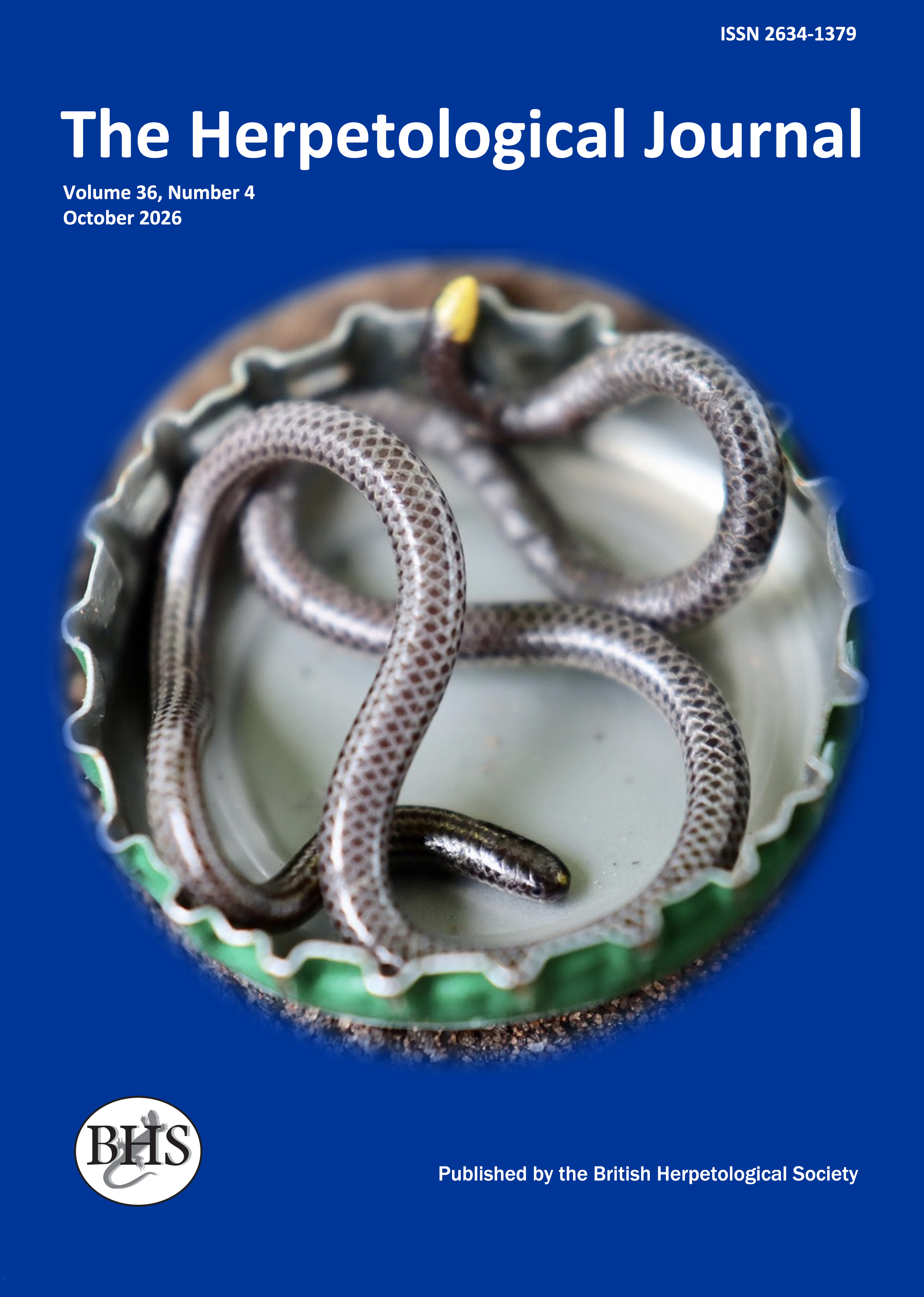
IMPORTANT NOTE - JUNE 2020
Please note that as from Volume 31 Number 1 (January 2021) on, the Herpetological Journal will be available as an online publication only - the last print edition will be Volume 30 Number 4.
Aligning with this change, it is now no longer possible to purchase a subscription that includes a print copy of the HJ. All members who have existing HJ print subscriptions that remain active as at end June 2020 will receive the full four 2020 print editions. New subscribers or renewals after this time will only have option to subscribe to the online only subscription package. Subscription pricing has been amended to reflect the content changes.