

The Herpetological Journal
The Herpetological Journal is the Society's prestigious quarterly scientific journal. Articles are listed in Biological Abstracts, Current Awareness in Biological Sciences,Current Contents, Science Citation Index, and Zoological Record.
ISSN 0268-0130
2023 Impact Factor for the Herpetological Journal is 1.1, with the Journal sitting just below Quartile 2 in Zoology, at percentile 46.9
03. Investigating diversity patterns and community dynamics of herpetofauna communities in a small Afrotropical wetland, Uganda
35 downloads
Subscription / purchase required
DOI: https://doi.org/10.33256/36.2.111124
pp. 111-124
Authors: Mathias Behangana, Raymond Katumba, Jimmy Muheebwa, Achilles Byaruhanga & Luca Luiselli
Abstract: Recent research has increasingly focused on the biodiversity patterns (community structure and diversity metrics) of amphibians and reptiles in tropical African wetlands. In this regard, Uganda is particularly interesting as, despite its relatively small size, it boasts the greatest biodiversity per unit area in Africa and a significant number of endemic vertebrates. The present study aims to analyse the herpetofauna communities of smaller Ugandan wetlands, using the Kaku-Kiyanja wetland (a 20 km² area) as a study case. In order to study the amphibian and reptile communities, we employed a suite of field methods, including visual surveys, dip-netting and audio-call identification, and we evaluated species richness, evenness and diversity patterns in a suite of different habitats. We also used multivariate statistical techniques (Detrended Correspondence Analysis) for spacing the various species in relation to the six type of areas, and a Poisson Generalised Linear Model with a log link to assess the effects of habitat type and taxonomic family on species abundance. A total of 28 sympatric species were identified, comprising 17 amphibian species and 11 reptile species. However, the estimated species richness for reptiles was substantially higher, as indicated by the Chao-1 estimator and species accumulation (saturation) curve analyses. Our GLM results demonstrate that species abundance was strongly shaped by habitat type, with a particular habitat type (IV, i.e. permanent wetland with open water, with scattered Typha and Cyperus papyrus stands) supporting markedly higher counts and Ptychadenidae disproportionately contributing to overall richness patterns across the landscape. GLMs also revealed significant variation in amphibian community diversity metrics—including Shannon diversity, Simpson index, evenness and species richness—across habitats, with some habitats showing lower diversity and higher dominance by a few species. Overall, these results underscore the ecological richness of the studied wetland despite its limited spatial extent. The species diversity observed in Kaku-Kiyanja is comparable to that documented in significantly larger wetland systems. Its ecological connectivity to surrounding water bodies may explain the relatively high species richness. However, we should acknowledge limitations such as suboptimal sampling, particularly for reptiles. Despite no threatened species being found, agricultural activities pose significant threats to the wetland's biodiversity, warranting future conservation efforts.
Keywords: community ecology, Amphibia, Reptilia, diversity metrics, Kaku-Kiyanja wetland, East Africa
Download Access:
The latest 8 issues can be downloaded when logged in with a Herpetological Journal subscription membership.
Individual articles can be purchased for download.
Older issues and occasional Open Access articles are available for public download
Submissions:
For further information and submission guidelines please see our Journal Instructions to Authors

Latest Issue
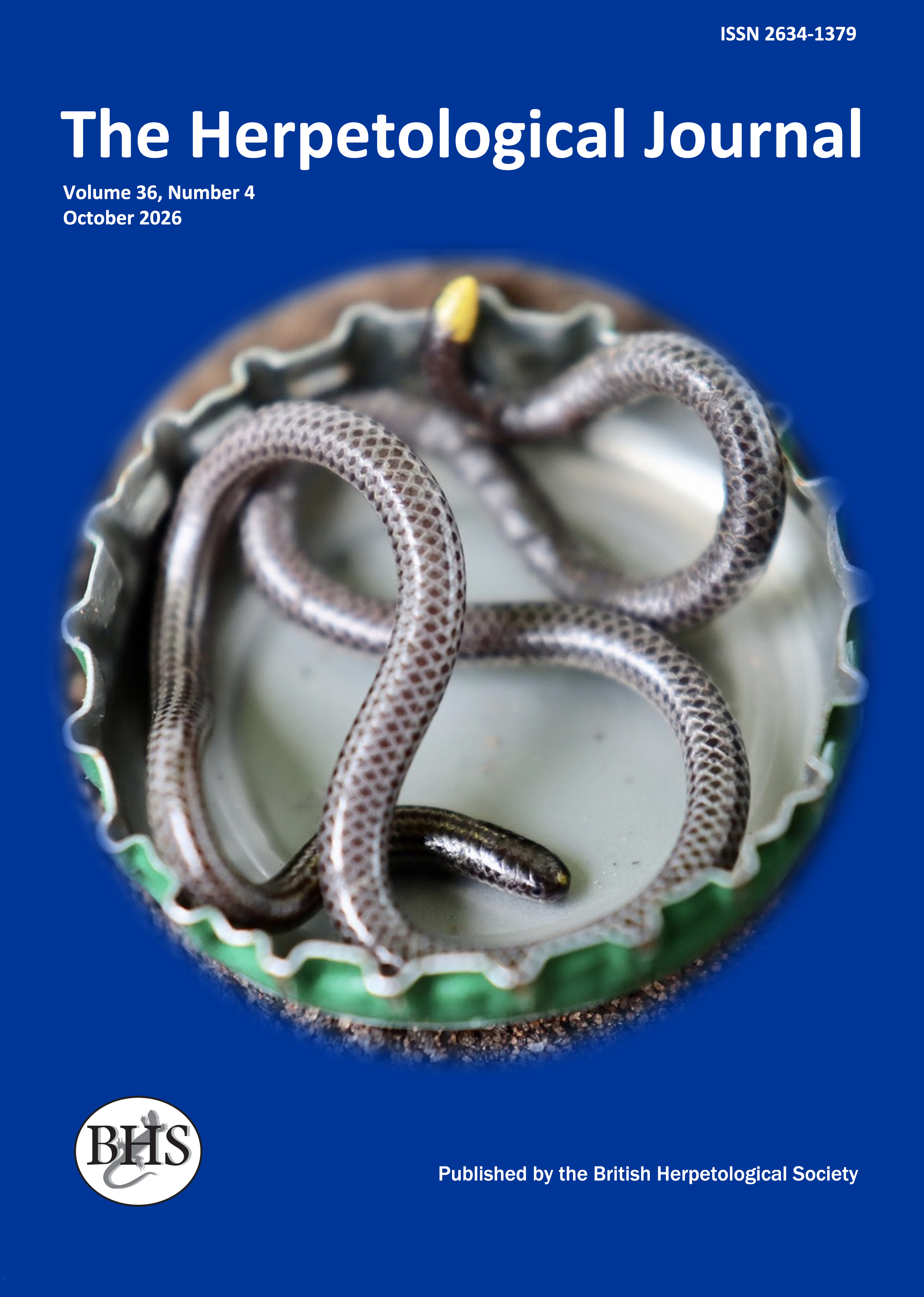
IMPORTANT NOTE - JUNE 2020
Please note that as from Volume 31 Number 1 (January 2021) on, the Herpetological Journal will be available as an online publication only - the last print edition will be Volume 30 Number 4.
Aligning with this change, it is now no longer possible to purchase a subscription that includes a print copy of the HJ. All members who have existing HJ print subscriptions that remain active as at end June 2020 will receive the full four 2020 print editions. New subscribers or renewals after this time will only have option to subscribe to the online only subscription package. Subscription pricing has been amended to reflect the content changes.