

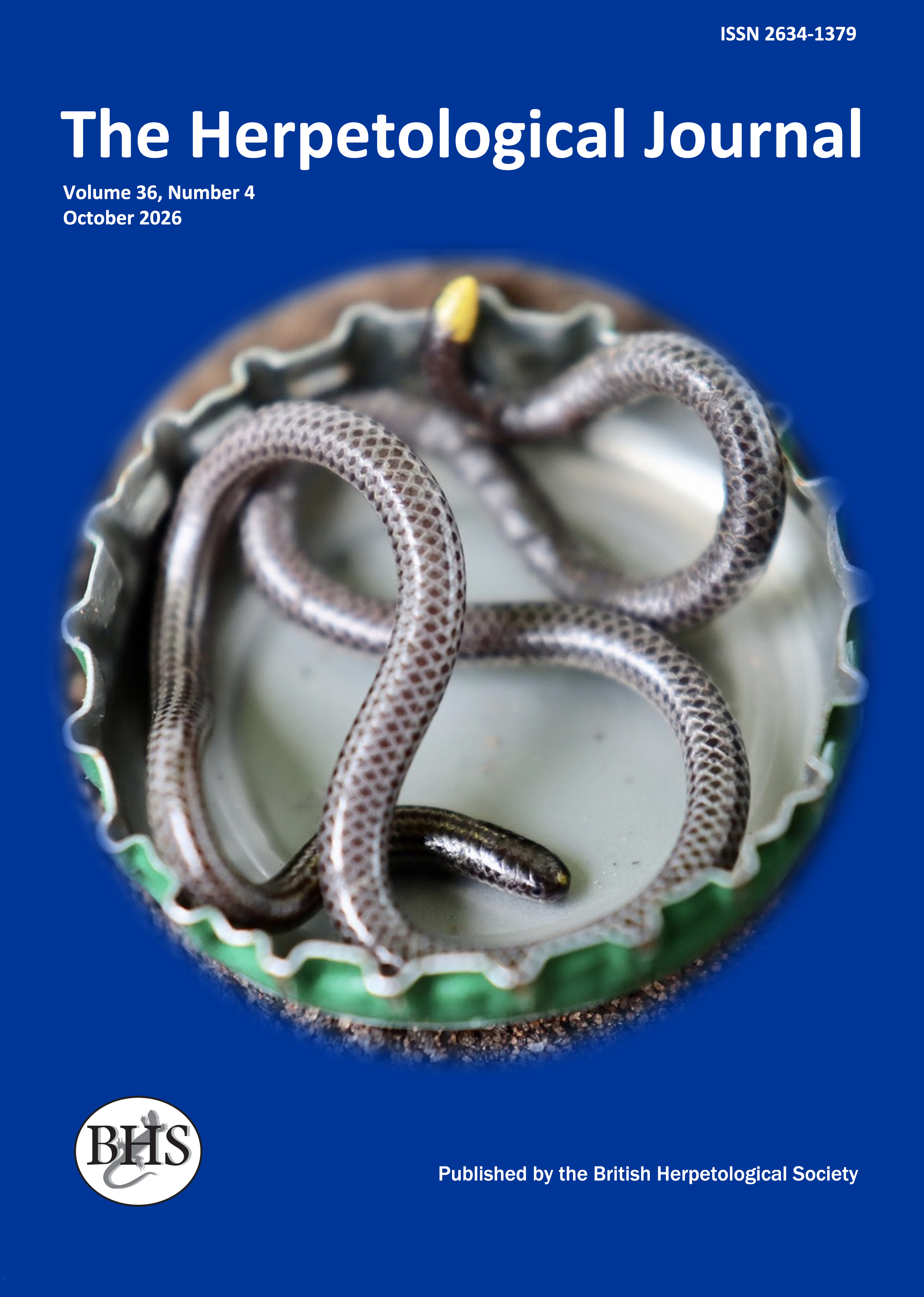
The Herpetological Journal
The Herpetological Journal is the Society's prestigious quarterly scientific journal. Articles are listed in Biological Abstracts, Current Awareness in Biological Sciences,Current Contents, Science Citation Index, and Zoological Record.
ISSN 0268-0130
2023 Impact Factor for the Herpetological Journal is 1.1, with the Journal sitting just below Quartile 2 in Zoology, at percentile 46.9
04. Discovery of a large communal hibernaculum of the Schmidt's whip snake Dolichophis schmidti in Georgia via social media
30 downloads
Subscription / purchase required
DOI: https://doi.org/10.33256/36.2.125130
pp. 125-130
Authors: Giorgi Iankoshvili, Ioane Rostiashvili, Andro Solomanashvili, Shota Zandukeli, Alisa Sanakoeva & Mariam Tsulaia
Abstract: Communal hibernation is prevalent among snakes of the temperate zone, however, it remains poorly documented for most species worldwide. We report the first documented interspecific snake hibernaculum in Georgia, identified after a local resident posted on TikTok. In total, we collected 135 snakes from a reinforced septic tank. Of these, 133 were identified as Dolichophis schmidti (Nikolsky, 1909) of different ages, with single specimens of Platyceps najadum (Eichwald, 1831) and Natrix tessellata (Laurenti, 1768). This find represents both the largest recorded aggregation of D. schmidti and the first interspecific snake hibernaculum documented in the Caucasus. The D. schmidti specimens showed a nearly balanced sex ratio with a slight female bias (52.6%) and a wide size range (total length 82–158 cm; mass 82–753 g), indicating multiple cohorts. Snakes occurred in the terminal chamber, where microclimatic conditions were most stable (11 °C). As construction posed an imminent threat, snakes were translocated from the discovery site and released in the spring. Our find demonstrates the importance of anthropogenic structures for successful communal hibernation in human-modified landscapes. This case also highlights the value of social media as an early-warning mechanism for conservation responses.
Keywords: Caucasus, Colubridae, citizen science, reptile behaviour, winter aggregation
Download Access:
The latest 8 issues can be downloaded when logged in with a Herpetological Journal subscription membership.
Individual articles can be purchased for download.
Older issues and occasional Open Access articles are available for public download
Submissions:
For further information and submission guidelines please see our Journal Instructions to Authors

Latest Issue
IMPORTANT NOTE - JUNE 2020
Please note that as from Volume 31 Number 1 (January 2021) on, the Herpetological Journal will be available as an online publication only - the last print edition will be Volume 30 Number 4.
Aligning with this change, it is now no longer possible to purchase a subscription that includes a print copy of the HJ. All members who have existing HJ print subscriptions that remain active as at end June 2020 will receive the full four 2020 print editions. New subscribers or renewals after this time will only have option to subscribe to the online only subscription package. Subscription pricing has been amended to reflect the content changes.