

The Herpetological Journal
The Herpetological Journal is the Society's prestigious quarterly scientific journal. Articles are listed in Biological Abstracts, Current Awareness in Biological Sciences,Current Contents, Science Citation Index, and Zoological Record.
ISSN 0268-0130
2023 Impact Factor for the Herpetological Journal is 1.1, with the Journal sitting just below Quartile 2 in Zoology, at percentile 46.9
03. Accounting for imperfect detection reveals terrain slope as key driver of occupancy for the fossorial snake Conopsis lineata in central Mexico
1 download
Subscription / purchase required
Authors: Camilo Alejandro Cruz-Arroyave, Carlos A. Yáñez-Arenas, Jaime Zúñiga-Vega & Hibraim A. Pérez-Mendoza
Abstract: Understanding the spatial distribution of fossorial snakes remains challenging due to their cryptic nature and low detectability, hindering conservation efforts for these threatened species. We used single-season occupancy models to identify fine-scale ecological drivers of distribution and detectability for Conopsis lineata, a fossorial snake endemic to central Mexico and threatened by urban expansion. Between May and October 2024, we surveyed 30 transects in the south of Mexico City, recording 36 individuals across 137 surveys. Our results revealed that detectability increased with the number of natural cover objects and decreased with maximum microhabitat temperatures above 30 °C, whilst occupancy was strongly associated with terrain slope, with snakes restricted to sites with slopes below 30 °. Contrary to expectations, snakes did not preferentially select microhabitats within their reported preferred temperature range (22–30 °C), with 61% of individuals found at cooler temperatures, suggesting that thermal selection may be constrained by predation risk or temporal availability of suitable temperatures under cover objects. Occupancy was better predicted by geomorphological features (maximum slope) than by vegetation characteristics or bioclimatic variables, supporting the scale domain hypothesis by empirical evaluation at fine-scale and supporting a previously reported association between fossorial snakes and flat terrain. This relationship is particularly concerning as low-slope areas in Mexico face intense pressure from urbanisation and agriculture. Our findings demonstrate that accounting for imperfect detection is crucial for understanding fossorial snake ecology and that terrain slope represents a key yet overlooked factor in their spatial distribution. These results provide actionable insights for conservation planning and sampling design for cryptic species, highlighting the urgent need for targeted environmental education campaigns in rural communities where human-snake encounters frequently result in snake mortality.
Keywords: occupancy, microhabitat use, imperfect detection, cryptic species, urbanisation, slope
Download Access:
The latest 8 issues can be downloaded when logged in with a Herpetological Journal subscription membership.
Individual articles can be purchased for download.
Older issues and occasional Open Access articles are available for public download
Submissions:
For further information and submission guidelines please see our Journal Instructions to Authors

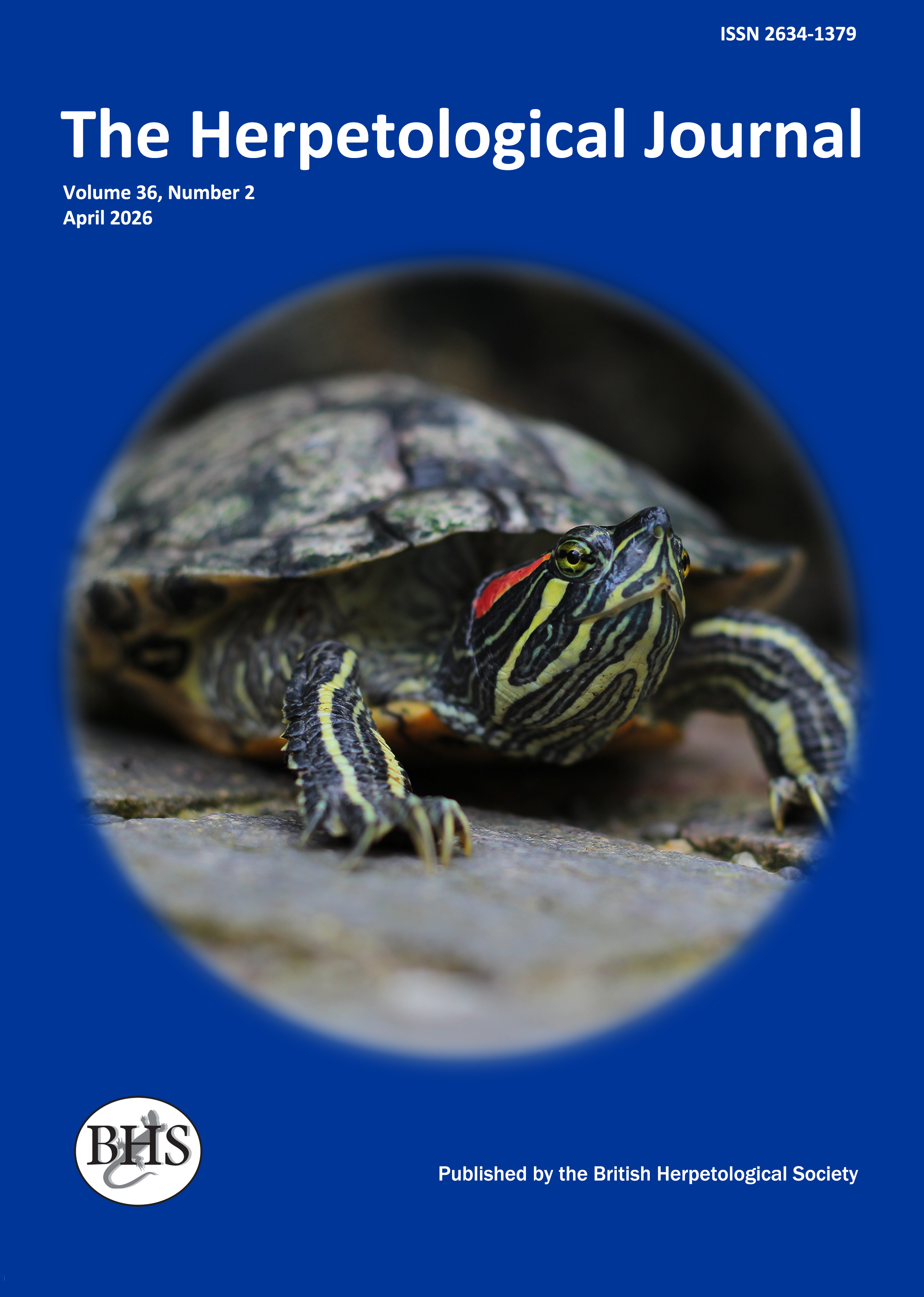
Latest Issue
IMPORTANT NOTE - JUNE 2020
Please note that as from Volume 31 Number 1 (January 2021) on, the Herpetological Journal will be available as an online publication only - the last print edition will be Volume 30 Number 4.
Aligning with this change, it is now no longer possible to purchase a subscription that includes a print copy of the HJ. All members who have existing HJ print subscriptions that remain active as at end June 2020 will receive the full four 2020 print editions. New subscribers or renewals after this time will only have option to subscribe to the online only subscription package. Subscription pricing has been amended to reflect the content changes.