

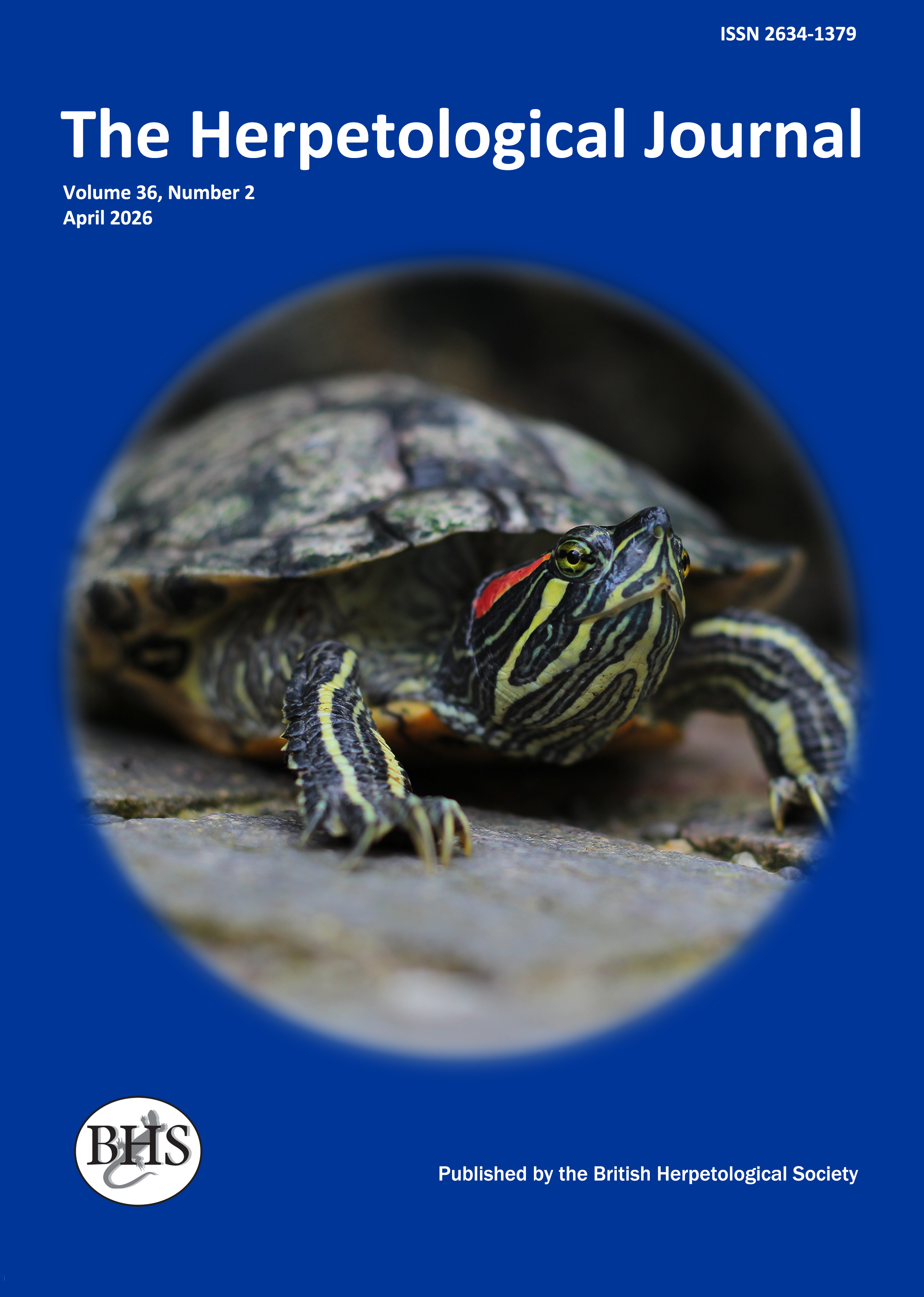
The Herpetological Journal
The Herpetological Journal is the Society's prestigious quarterly scientific journal. Articles are listed in Biological Abstracts, Current Awareness in Biological Sciences,Current Contents, Science Citation Index, and Zoological Record.
ISSN 0268-0130
2023 Impact Factor for the Herpetological Journal is 1.1, with the Journal sitting just below Quartile 2 in Zoology, at percentile 46.9
05. Fine-scale dietary variation and low repeatability of prey use across adjacent microhabitats in a West African urban generalist gecko
1 download
Subscription / purchase required
Authors: Daniele Dendi, Gabriel Hoinsoudé Segniagbeto, Fabio Petrozzi & Luca Luiselli
Abstract: Dietary generalism promotes ecological flexibility, yet the consistency of prey use across nearby habitats remains poorly understood. We investigated fine-scale variation and repeatability of diet in the West African gecko Hemidactylus angulatus, an urban generalist, across six adjacent houses (four) and walls (two) on the University of Lomé campus, Togo. Faecal analysis from 97 individuals revealed a broad arthropod diet dominated by Diptera and Hymenoptera, with additional prey from Lepidoptera, Araneae and Isopoda. Levin’s standardised niche breadth indices (BA) revealed moderate to high dietary niche breadth across all sites, with BA values ranging from 0.55 to 0.60. Diversity indices showed moderate to high prey richness and evenness, while Bray-Curtis dissimilarity values (23–42%) indicated substantial dietary turnover among sites separated by only tens of metres. Detrended Correspondence Analysis linked dietary composition and diet variability to microhabitat variables, particularly structure height, vegetation cover and refuge availability. Geckos inhabiting taller, more structurally complex microhabitats exhibited broader diets, whereas those in simpler habitats consumed more specialised prey. These results reveal low consistency of prey use among nearby microhabitats by an urban generalist and highlight how microhabitat heterogeneity drives fine-scale trophic differentiation, emphasising the ecological significance of structural complexity in urban environments. By demonstrating that small-scale structural heterogeneity promotes trophic diversification even in urban generalists, our findings indirectly highlight the potential importance of maintaining microhabitat complexity in cities to support urban biodiversity, ecosystem functioning and the conservation value of human-dominated landscapes.
Keywords: dietary generalism, microhabitat heterogeneity, urban environments, Hemidactylus, trophic diversity, spatial dietary variation
Download Access:
The latest 8 issues can be downloaded when logged in with a Herpetological Journal subscription membership.
Individual articles can be purchased for download.
Older issues and occasional Open Access articles are available for public download
Submissions:
For further information and submission guidelines please see our Journal Instructions to Authors

Latest Issue
IMPORTANT NOTE - JUNE 2020
Please note that as from Volume 31 Number 1 (January 2021) on, the Herpetological Journal will be available as an online publication only - the last print edition will be Volume 30 Number 4.
Aligning with this change, it is now no longer possible to purchase a subscription that includes a print copy of the HJ. All members who have existing HJ print subscriptions that remain active as at end June 2020 will receive the full four 2020 print editions. New subscribers or renewals after this time will only have option to subscribe to the online only subscription package. Subscription pricing has been amended to reflect the content changes.