

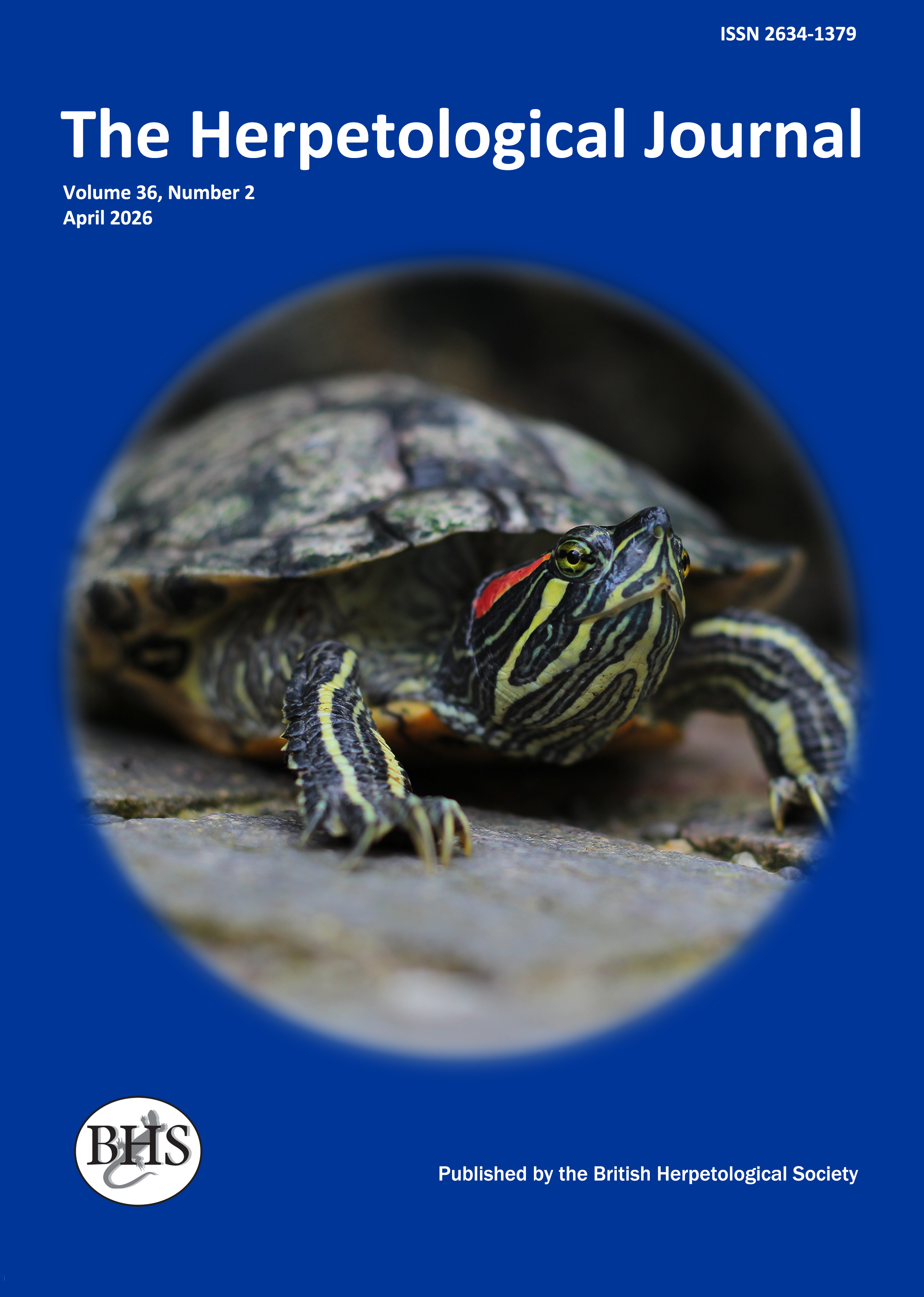
The Herpetological Journal
The Herpetological Journal is the Society's prestigious quarterly scientific journal. Articles are listed in Biological Abstracts, Current Awareness in Biological Sciences,Current Contents, Science Citation Index, and Zoological Record.
ISSN 0268-0130
2023 Impact Factor for the Herpetological Journal is 1.1, with the Journal sitting just below Quartile 2 in Zoology, at percentile 46.9
07. Year-to-year variation in core body temperatures of nesting leatherback and hawksbill sea turtles
1 download
Subscription / purchase required
AUTHOR: Malcolm W. Kennedy
ABSTRACT: Using non-contact infrared thermometers, the surface temperatures of freshly laid eggs of sea turtles were measured as proxies of core body temperatures while they were nesting. Data were accumulated over seven consecutive nesting seasons for two species with contrasting lifestyles – leatherbacks Dermochelys coriacea, the largest, which are anatomically adapted to migrate between tropical breeding sites to cold temperate waters, and the smaller hawksbills Eretmochelys imbricata that are generally confined to the tropics and sub-tropics. Leatherbacks ranged between 28.7 °C and 32.5 °C (30.9 °C ± 0.6 °C; mean ± standard deviation) and hawksbills 26.3 °C to 32.0 °C (29.2 °C ± 0.8 °C), with year-to-year variations in temperatures in populations of both species (year mean 30.4 °C to 31.5 °C in leatherbacks), hawksbills the more so (28.1 °C to 30.3 °C). These differences will likely be modified by both natural seasonal variations, anthropogenic changes in ocean temperatures and variabilities in currents and water temperatures local to nesting beaches. Such diversities in body temperatures of nesting turtles are pertinent to predicting environmental tolerances, reproductive success and nest site selection, and could contribute to predicting which rookeries may remain viable or not as oceans warm.
Keywords: Dermochelys coriacea, Eretmochelys imbricata, core body temperatures, egg surface temperatures, oviposition
Download Access:
The latest 8 issues can be downloaded when logged in with a Herpetological Journal subscription membership.
Individual articles can be purchased for download.
Older issues and occasional Open Access articles are available for public download
Submissions:
For further information and submission guidelines please see our Journal Instructions to Authors

Latest Issue
IMPORTANT NOTE - JUNE 2020
Please note that as from Volume 31 Number 1 (January 2021) on, the Herpetological Journal will be available as an online publication only - the last print edition will be Volume 30 Number 4.
Aligning with this change, it is now no longer possible to purchase a subscription that includes a print copy of the HJ. All members who have existing HJ print subscriptions that remain active as at end June 2020 will receive the full four 2020 print editions. New subscribers or renewals after this time will only have option to subscribe to the online only subscription package. Subscription pricing has been amended to reflect the content changes.