

The British Herpetological Society

The Herpetological Bulletin is a quarterly publication in English. It includes full-length papers, natural history notes, book reviews, and other items of general herpetological interest. Emphasis is placed on natural history and conservation as well as captive care that includes breeding, husbandry, veterinary, and behavioural aspects.
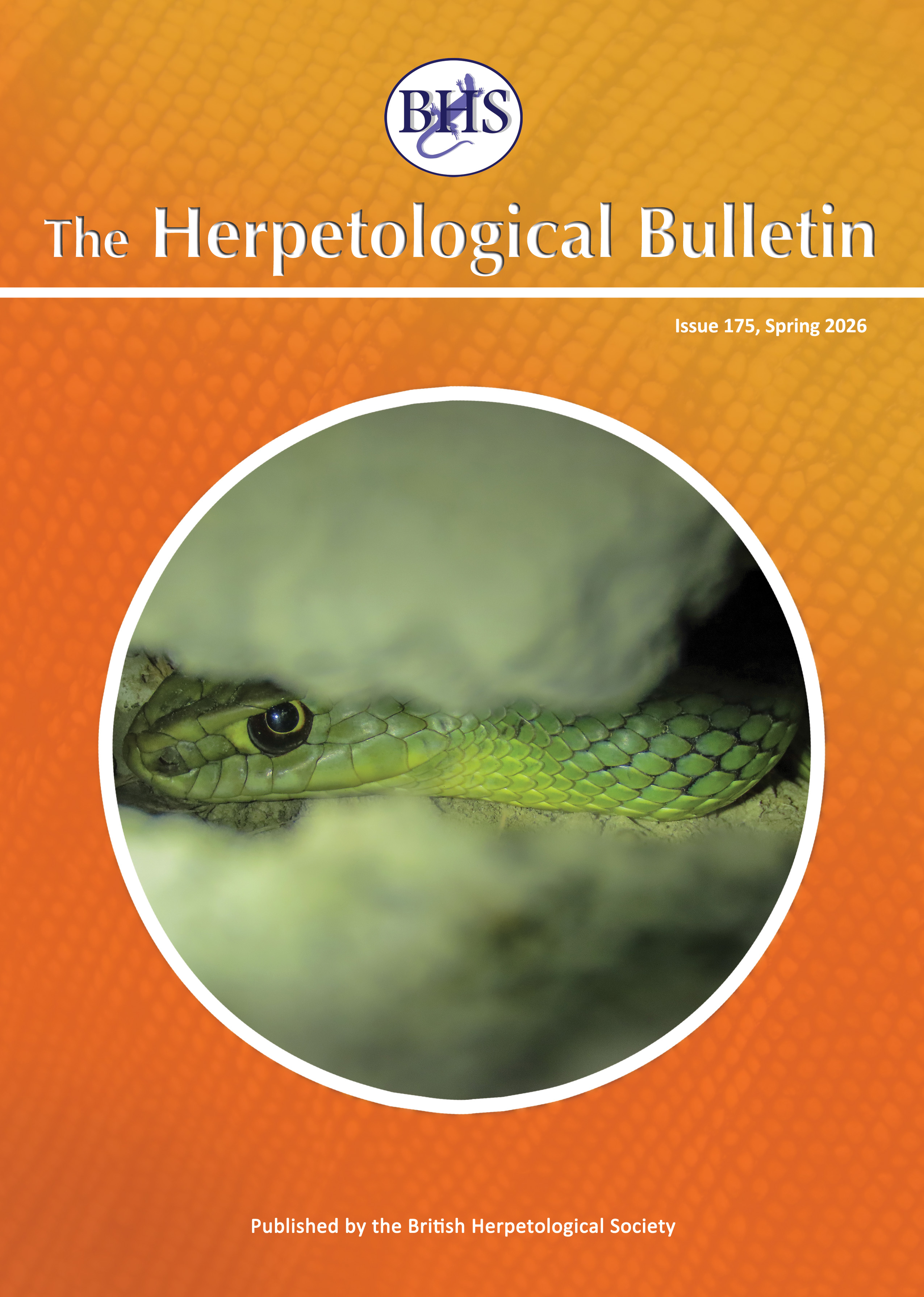

Issue Number 175 - Spring 2026 Issue Number 175 - Spring 2026


pdf 01. Some insights into the thermoregulation strategies of Amazonian caimans from ingested temperature sensors and thermal imaging

6 downloads

Subscription required

https://doi.org/10.33256/hb175.17

AUTHORS: FRANCOIS CLARAC, ZILCA CAMPOS, MARGO TRAIMOND & OLIVIER MARQUIS

ABSTRACT: We investigated the body temperature of three captive caiman species Paleosuchus palpebrosus, Caiman crocodilus and Melanosuchus niger. These are all inhabitants of the Amazonian basin and share an ecto-poikilothermic metabolism typical of extant crocodylians. In the wild, these species occupy different habitats and have distinct ecological requirements that relate to their size differences, which range from the world’s smallest caiman species P. palpebrosus to M. niger that may exceed 5 m in length. We confirm that P. palpebrosus is a thermoconformer whereas C. crocodilus and M. niger are active thermoregulators. It appears that there are correlations between the kinds of habitats occupied by each species and their thermoregulatory strategies. Furthermore, we provide some data showing that the two thermoregulating species use the extended vascular network of the skull and dorsal osteoderms to store heat.


pdf 02. Influence of artificial refuge type on the success of a presence/absence surveys for slow worms Anguis fragilis

10 downloads

Subscription required

https://doi.org/10.33256/hb175.813

AUTHORS: HANNAH REGIS, CHANTAL HELM & ALLA MASHANOVA

ABSTRACT: Artificial refuges are widely used to improve detection rates when surveying for reptiles. We compared the efficacy of refuges constructed from four different materials to detect slow worms Anguis fragilis. The refuges included two types that were flat - roofing felt (bitumen) and carpet tiles, and two types that were corrugated - one constructed of roofing felt (bitumen-soaked fibres) and the other of metal. The proportion of occupied refuges (i.e. sheltering at least one slow worm) varied greatly by month with the highest proportions in June. The effect of refuge type was not statistically significant on its own, but the interaction between the type and month was significant. The proportion of occupied refuges was most affected by refuge type in the months with intermediate slow worm occupancy rates (May & July). Flat roofing felt and the corrugated roofing felt appear to be the most different, the former higher in July and the latter higher in May and June. Using a mixture of refuge types simultaneously during surveys could potentially increase the detection rate of slow worms.


pdf 03. Indigenous knowledge contributes to the sustainability of chameleon populations: A case study from Mount Manengouba, Cameroon

2 downloads

Subscription required

https://doi.org/10.33256/hb175.1419

AUTHORS: LEGRAND N. GONWOUO, MARINA KAMENI N., ARNAUD M. TCHASSEM F., NGOE FAI ESANGE, WALTER P. TAPONDJOU N. & KATLIN E. ALLEN

ABSTRACT: The Mouamenam clan of the Bakossi community from Mount Manengouba, Cameroon, considers the local forest to be sacred, and therefore the species within should be protected. This forest hosts four endemic chameleon species that are protected by this community and used by traditional authorities for rituals. Knowledge regarding these chameleon species has been perpetuated over generations and reflects the relationship between the Bakossi community and ‘old-nature’ practices. The environmental ethics expressed through these traditional beliefs are useful tools in natural resource conservation. However, increasing modernisation and a lack of motivation among local youth to perpetuate indigenous knowledge may have dire consequences for the biodiversity of the area. It is suggested that combining local indigenous practices with scientific knowledge would contribute to the effective protection of these chameleon species.


pdf 04. Exercise-wheel enrichment for a captive leopard gecko Eublepharis macularius: An assessment of distance travelled

8 downloads

Open Access

https://doi.org/10.33256/hb175.2023

AUTHOR: RICHARD DIGIROLAMO

ABSTRACT: Environmental enrichment is an understudied aspect of reptilian welfare. The daily distance travelled (DDT) by a captive leopard gecko on an exercise wheel was investigated for 12 months. The gecko used the wheel voluntarily and the overall mean DDT was 161.25 m but varied widely with mean monthly temperature. Behavioural observations indicated a preference for access to the wheel, as evidenced by exploratory behaviour upon its removal and immediate resumption of use upon reintroduction. This suggests that exercise wheels can serve to increase leopard gecko locomotor activity and thereby enhance welfare.


pdf 05. Have great crested newts Triturus cristatus translocated to a pond in mid-Wales been detrimental to existing amphibian populations?

16 downloads

Open Access

https://doi.org/10.33256/hb175.2427

AUTHOR: FRED SLATER

ABSTRACT: In the period 1981–1985, our amphibian research was focused on a large pond in mid-Wales where on average 1,400 common toads Bufo bufo, a combined population of some 3,000 smooth newts Lissotriton vulgaris and palmate newts Lissotriton helveticus, and some 200 female common frogs Rana temporaria bred regularly. In the mid-1990s an unintentional release of some great crested newt eggs, larvae or efts took place and by 2008 fifty great crested newts were trapped entering the pond. By 2022, only one clump of frog spawn and two strings of toad spawn were found together with noticeably fewer Lissotriton spp., particularly smooth newts, with great crested newts becoming the dominant amphibian species. From 2023 to 2025 no anuran spawn was found in the pond and by 2024 it became difficult to find Lissotriton newts, but torchlight surveys of great crested newts in early April gave an estimated population of 500. A similar survey in April 2025 gave similar results. Visits from anuran predators, otter Lutra lutra, buzzard Buteo buteo and grey heron Ardea cinerea have also declined suggesting a food chain effect related to increasing great crested newt numbers.


pdf 06. Bite, hold and vibrate: Courtship behaviour in the Brazilian glass lizard Ophiodes fragilis

1 download

Subscription required

https://doi.org/10.33256/hb175.2831

AUTHORS: SILVIA REGINA TRAVAGLIA-CARDOSO, VANESSA RITCHEL, PAMELA S. SANTOS & ERIKA HINGST-ZAHER

ABSTRACT: This is the first report of courtship behaviour in the Brazilian glass lizard Ophiodes fragilis, a poorly known viviparous anguid lizard with vestigial hindlimbs. Four courtship interactions were observed in a naturalistic captive enclosure. The courtship sequence involves male pursuit, body positioning over the female, head rubbing along the female’s body, biting of the female’s nuchal region, and vibration of vestigial hindlimbs against the female’s body. Of particular interest is the apparent use of vestigial hindlimbs for sexual stimulation and the vigorous biting of the female’s neck during courtship. These observations contribute to our understanding of reproductive strategies in limbless and limb-reduced squamates. They also highlight the importance of observations of reptiles maintained in captivity to improve our knowledge of their natural history.


pdf 08. Underwater tongue-flicks by a non-aquatic snake species, the nose-horned viper Vipera ammodytes

6 downloads

Open Access

https://doi.org/10.33256/hb175.3435

AUTHORS: KOSTADIN ANDONOV, ANGEL DYUGMEDZHIEV, SIMEON LUKANOV, EMILIYA VACHEVA & BORISLAV NAUMOV


pdf 09. Updated distribution of North African rock agama Agama bibronii in Algeria

1 download

Subscription required

https://doi.org/10.33256/hb175.3637

AUTHORS: TAYEB DJETTI, MOHAMED BELKACEM, MOHAMED MAIRIF, OUSSAMA AILAM, HAMID CHERIER, MILOUD ABIDAT & BELKACEM AIMENE BOULAOUAD


pdf 09a. Supplementary material for 09. Updated distribution of North African rock agama Agama bibronii in Algeria

2 downloads

Subscription required

AUTHORS: TAYEB DJETTI, MOHAMED BELKACEM, MOHAMED MAIRIF, OUSSAMA AILAM, HAMID CHERIER, MILOUD ABIDAT & BELKACEM AIMENE BOULAOUAD


pdf 10. First documentation of Yang’s frill-limbed tree frog Kurixalus yangi from Meghalaya, India

1 download

Subscription required

https://doi.org/10.33256/hb175.3840

AUTHORS: HOLINESS WARJRI, MADHURIMA DAS & JAYADITYA PURKAYASTHA


pdf 10a. Supplementary material for 10. First documentation of Yang’s frill-limbed tree frog Kurixalus yangi from Meghalaya, India

2 downloads

Subscription required

AUTHORS: HOLINESS WARJRI, MADHURIMA DAS & JAYADITYA PURKAYASTHA


Download Access:

The latest 4 issues can be downloaded when logged in as a BHS member.

Older issues are available for public download

Submissions:

For further information and submission guidelines see our Instructions to Authors - The Herpetological Bulletin

pdfBHS Ethics Policy

Search Publications